A statutory notification is a report the registered person must send to the Care Quality Commission about a change, an event or an incident. CQC's notifications guidance, updated on 20 May 2025, says the regulations state what must be notified and the timescale, and that it is an offence not to notify CQC when a relevant change, event or incident has happened.
This guide is for an agency registered with CQC in England. Scotland, Wales and Northern Ireland have their own regulators. How those systems differ is in home care compliance in the four UK nations. The summary below follows the Care Quality Commission (Registration) Regulations 2009 and the pages CQC publishes beside them. Apply it to a live case with your own advice.
Two other duties often arise from the same event. Speaking to the person is the duty of candour. Raising a concern with the local authority is safeguarding. Each has its own test. Sending one of them does not complete the others.
Who has to send it
CQC's guidance says the registered person must submit notifications. Registered persons are the organisation, partnership or individual registered to provide the regulated activity, and any manager registered for that activity. The task can be delegated. The registered person stays responsible for the notification being made correctly, and CQC says the delegation arrangements have to be clear.
CQC says it uses notifications to know what is happening in a service, to identify concerns, to decide whether regulatory action is needed, and to monitor trends.
An independent home care agency sends these notifications to CQC. The same guidance says NHS trusts and NHS Blood and Transplant can submit some notifications through the Learn from Patient Safety Events service, and that primary medical services can submit death notifications that way. That route is not the one written for an independent domiciliary agency.
The events, and the clock
CQC's notifications list is the index. The timescale depends on the type. For several incidents the regulation says "without delay". CQC's form pages for a death, for police involvement, and for an event that stops the service running safely say to notify as soon as possible. The regulations do not state a number of hours.
| What you are reporting | The test in the regulations | When |
|---|---|---|
| Death of a person using the service | While the regulated activity was being provided, or the death has or may have resulted from it | Without delay |
| Serious injury | The harm test in Regulation 18, during the activity or as a consequence of it | Without delay |
| Abuse or an allegation of abuse | In relation to a service user | Without delay |
| Police involvement | An incident reported to, or investigated by, the police | Without delay |
| The service cannot carry on safely | Including too few suitable staff, or a utility or safety-device failure of more than 24 hours in premises the provider owns or uses | Without delay |
| Deprivation of liberty outcome | The outcome of a standard authorisation request, or of a court application under section 16(2)(a) of the Mental Capacity Act 2005, or the withdrawal of either | Once the outcome is known, or at withdrawal |
| Absence of the registered manager, or of an individual provider in day to day charge | A continuous period of 28 days or more | 28 days before a planned absence; 5 working days in an emergency; forthwith if 28 days have already passed with no notice |
| Return from that absence | The person has returned | No later than 7 working days after the return |
| Who carries on or manages the activity, officers, the nominated individual, insolvency | Regulation 15 | As soon as reasonably practicable |
| A revision of the statement of purpose | Regulation 12 | Within 28 days of the revision |
Deaths
Regulation 16 is the death notification. For a registered person who is not in the categories in paragraph (2), the duty is to notify CQC without delay of the death of a service user in either of two cases:
- the death happened while services were being provided in the carrying on of a regulated activity
- the death has resulted, or may have resulted, from the carrying on of a regulated activity
Paragraph (2) is a different test. It applies where the service provider is a health service body, a local authority exercising public health functions, or a provider of primary medical services. That paragraph adds a condition about the death not being attributable, in the registered person's reasonable opinion, to the course the illness or condition would naturally have taken. An independent home care agency is not in those categories, so it follows paragraph (1). Paragraph (1) does not contain that natural-course condition.
The notification must include a description of the circumstances of the death. CQC's death form, updated on 20 May 2025, says to notify as soon as possible, either in the provider portal or by emailing the current Word form to HSCA_notifications@cqc.org.uk. An incomplete form is returned.
Regulation 16(5) says this regulation does not apply where Regulation 17 applies. Regulation 17 is the notification of the death, or the unauthorised absence, of a service user who is detained or liable to be detained under the Mental Health Act 1983. CQC's guidance on Regulation 16 says a notification is not required under Regulation 16 where it relates to that death or absence.
CQC says it can prosecute for a breach of Regulation 16, or part of it, and that it can move directly to prosecution without first serving a warning notice.
Serious injury
Regulation 18 requires the registered person to notify CQC without delay of specified incidents which occur while services are being provided in the carrying on of a regulated activity, or as a consequence of it.
CQC's page on Regulation 18, updated on 20 May 2025, says providers must notify CQC of all incidents that affect the health, safety and welfare of people who use services, and that the full list is in the regulation.
For injury, the regulation uses the reasonable opinion of a health care professional. It defines a health care professional as a person registered in a profession to which section 60(2) of the Health Act 1999 applies. The injury must have resulted in one of the following, or require treatment by a health care professional to prevent death or to prevent an injury which, if untreated, would lead to one of them:
- an impairment of sensory, motor or intellectual functions which is not likely to be temporary
- changes to the structure of the body
- prolonged pain or prolonged psychological harm
- the shortening of life expectancy
The regulation defines prolonged pain and prolonged psychological harm as pain or harm experienced, or likely to be experienced, for a continuous period of at least 28 days. A sensory, motor or intellectual impairment is not temporary if it has lasted, or is likely to last, for a continuous period of at least 28 days.
CQC's guidance on that paragraph gives examples and says the lists are not exhaustive. They include permanent damage, or damage that lasts or is likely to last more than 28 days, to sight, hearing, touch, smell or taste, to a major organ including the brain and skin, to bones, muscles, tendons, joints or vessels, and to intellectual functions. The examples also include the development after admission of a pressure sore of grade 3 or above that develops after the person has started to use the service. They include psychological harm, including post traumatic stress disorder, other stress that requires clinical treatment or support, psychosis, clinical depression and clinical anxiety. CQC's list of intellectual functions names intelligence, speech, thinking, remembering, making judgments and solving problems.
CQC's serious injury form, updated on 20 May 2025, says to tell CQC where the person was seriously injured while a regulated activity was being provided, or the injury may have been a result of the regulated activity or how it was provided. Where the serious injury is the result of an assault, that page says to use the allegation of abuse form instead. The form can be sent through the provider portal, or by emailing the current Word form to HSCA_notifications@cqc.org.uk.
Abuse, and a report to the police
Regulation 18 also requires notification, without delay, of any abuse or allegation of abuse in relation to a service user. For this regulation, abuse means:
- sexual abuse
- physical or psychological ill-treatment
- theft, misuse or misappropriation of money or property
- neglect and acts of omission which cause harm or place a person at risk of harm
CQC's abuse form, updated on 20 May 2025, says to tell CQC where a person using the service is affected by abuse or alleged abuse, or is an abuser or an alleged abuser. The same two routes apply: the portal, or the current Word form emailed to HSCA_notifications@cqc.org.uk.
That notification is the report to CQC. The safeguarding guide sets out the separate duty to the local authority, including Regulation 13 of the Health and Social Care Act 2008 (Regulated Activities) Regulations 2014.
Regulation 18(2)(f) requires notification of any incident which is reported to, or investigated by, the police, again where it occurs while services are being provided or as a consequence of the regulated activity. Paragraph (3) says this police notification does not apply where the service provider is an English NHS body. CQC's police form says NHS trusts do not need to notify CQC about police attendance, and that the notification should be made as soon as possible. It also says not to use the police form where a person using the service was affected by a death, a serious injury or abuse. Those use their own forms.
CQC says it can prosecute for a breach of Regulation 18, or part of it, without first serving a warning notice.
When the agency cannot cover the work safely
Regulation 18(2)(g) is the notification for an event which prevents, or appears to the provider likely to threaten to prevent, the provider carrying on the regulated activity safely, or in accordance with the registration requirements. The regulation includes four examples:
- an insufficient number of suitably qualified, skilled and experienced persons employed for the purpose of carrying on the regulated activity
- an interruption, lasting more than a continuous period of 24 hours, in the supply of electricity, gas, water or sewerage to premises owned or used by the provider for the regulated activity
- physical damage to premises owned or used by the provider for the regulated activity, which has or is likely to have a detrimental effect on the care provided
- failure or malfunction, lasting more than a continuous period of 24 hours, of fire alarms or other safety devices in those premises
The 24-hour period is in the regulation for the utility interruption and for the failure of fire alarms or other safety devices. It is not written into the staffing example.
CQC's form for events that stop a service running safely, updated on 20 May 2025, says to notify CQC as soon as possible where you cannot meet people's assessed needs safely, for example because of staff absence or damage to premises, or where a utility, fire alarm, call systems or other safety equipment fails for more than 24 hours. The page says to submit the notification online or by email.
A late or missed visit is not named as its own category. The visit record is still how an agency sees whether it still has enough suitable staff to meet assessed needs. Electronic call monitoring is that record. The notification, where the regulation is met, is a separate report.
Medicines errors, and outbreaks
CQC's notifications guidance draws a line around medicines errors. It says to notify CQC only where a medicines error causes an allegation of abuse, the death of a person using the service, an incident reported to or investigated by the police, or a serious injury. In that notification, CQC says to make clear that a medicine error was a known or possible cause or effect.
The same page does not treat an outbreak of infection as one of the notification types in the list. It directs providers to GOV.UK guidance on reporting notifiable diseases and causative organisms. The current guidance is Notifiable diseases and how to report them. The duty in regulation 2 of the Health Protection (Notification) Regulations 2010 sits with a registered medical practitioner who is attending the patient.
Deprivation of liberty: notify the outcome
Regulation 18 also requires a notification of two further events, where they occur while services are being provided or as a consequence of the regulated activity:
- a request the registered person makes to a supervisory body, under Part 4 of Schedule A1 to the Mental Capacity Act 2005, for a standard authorisation
- an application the registered person makes to a court, under section 16(2)(a) of that Act, in relation to depriving a service user of their liberty
The regulation says this notification is given once the outcome of the request or application is known or, if it is withdrawn, at the point of withdrawal. It must include the date and nature of the request or application, whether an urgent authorisation preceded it, the outcome or the reason for withdrawal, and the date of that outcome or withdrawal.
The regulation defines a supervisory body by reference to a hospital in England or a care home. CQC's notifications list includes the outcome of an application to deprive a person of their liberty. The safeguarding guide sets out how CQC distinguishes hospitals and care homes from other services on deprivation of liberty.
An absence of 28 days
Regulation 14 is about the service still being managed. It applies where the registered manager, or the service provider if that provider is the person in day to day charge, proposes to be absent from carrying on or managing the regulated activity for a continuous period of 28 days or more.
Except in an emergency, the notice has to be given no later than 28 days before the absence starts, or within a shorter period agreed with CQC. An emergency absence is notified within 5 working days of its occurrence. Where the absence has already lasted a continuous period of 28 days or more and CQC has not been told, the notice must be given forthwith. The return to duty is notified no later than 7 working days after the date of return.
The notice has to cover the length or expected length, the reason, the arrangements for managing the regulated activity, and the name, address and qualifications of the person who will be responsible. For a registered manager's absence it also covers the arrangements for appointing another person to manage during the absence, including the proposed date of that appointment.
The regulation defines a working day as any day other than a Saturday, a Sunday, Christmas Day, Good Friday, or a bank holiday in England and Wales. Subject to one exception for a health service body which has a registered manager condition, Regulation 14 does not apply where the service provider is a health service body.
CQC's absence form says a planned absence is notified 28 days before it starts, and that a provider who cannot give 28 days' notice should contact HSCA_notifications@cqc.org.uk. An emergency absence is notified within 5 working days of the start. The form is emailed to that address. The return form says the return is notified within 7 days after the date of return, again by email to HSCA_notifications@cqc.org.uk.
CQC says it can prosecute for a breach of Regulation 14 without first serving a warning notice.
Changes to who runs the service
Regulation 15 requires written notice to CQC, as soon as reasonably practicable, where any of the following takes place or is proposed:
- a person other than the registered person carries on or manages the regulated activity
- a registered person ceases to carry on or manage the regulated activity
- an individual registered person changes their name
- a partnership changes its membership
- a body changes its name or address, its director, secretary or similar officer, or its nominated individual
- a trustee in bankruptcy is appointed over an individual provider, or a receiver, manager, liquidator or provisional liquidator is appointed over a company or partnership
CQC's page on Regulation 15 describes this as telling CQC when the person who manages or carries on the service changes, when registered details change, when the registered person becomes financially insolvent, and when the service closes. It says CQC can prosecute for a breach without first serving a warning notice. The page says there is no further guidance beyond the regulation, and that providers must use CQC's forms.
A change of registered manager has a further step. CQC's page on that change, updated on 6 August 2024, says to notify CQC when there are changes to who is managing the regulated activity or locations, including where a manager is going to register, to add or remove activities or locations, or to cancel their manager registration. The current form, sections 1 and 2, is emailed to HSCA_applications@cqc.org.uk. CQC says that once the change has been notified, the registered manager must apply to change their registration. If the change affects the statement of purpose, that has to be amended as well. What registration of a manager involves for a new provider is set out in the CQC registration guide.
The statement of purpose
Regulation 12 requires a statement of purpose containing the information in Schedule 3, and requires the registered person to keep it under review and revise it where appropriate. Written details of any revision must be provided to CQC within 28 days of the revision.
Schedule 3 lists the aims and objectives, the kinds of services and the range of needs they are intended to meet, the name and contact details of the provider and any registered manager, the legal status of the provider, and the locations at which the regulated activity is carried on.
CQC's statement of purpose form, updated on 11 March 2024, says the provider must keep the statement up to date, notify CQC of any changes, and send a revised copy with the notification. The form is emailed to HSCA_applications@cqc.org.uk. CQC says it updates the registration details once it has processed the notification.
What the form may name
CQC's notifications guidance says that, for most notifications about a person using the service, the person is not identified by name. The form asks for a unique identifier or code. CQC says not to use the person's name, date of birth, NHS number, or another unique detail such as a room number. The provider must keep a record of who the code refers to, safely and securely. The exception on that page is the death of a person detained under the Mental Health Act 1983, where the name and date of birth are required.
The same page says forms ask about protected characteristics under the Equality Act 2010, because CQC must monitor how services meet people's diverse needs.
Use the current form. CQC says it updates the forms often, and that each notification page explains whether the portal, a Word form, or both can be used. A portal submission receives a reference number automatically. A Word form is acknowledged by email with a reference number. CQC says further correspondence should quote that number. On the death, serious injury, abuse and police form pages, CQC says that while its systems are being upgraded the acknowledgement may be an ENQ reference, a notification ID, or a case ID.
It is an offence to miss a required notification
Regulation 25 says a contravention of, or a failure to comply with, any of the provisions of regulations 12 and 14 to 20 is an offence. On summary conviction the person is liable to a fine not exceeding level 4 on the standard scale.
Schedule 5 to the Health and Social Care Act 2008 (Regulated Activities) Regulations 2014 lists that offence as a fixed penalty offence. The fixed penalty shown there is £1,250 where the offence is committed by a service provider, and £625 where it is committed by a registered manager.
CQC's guidance pages on regulations 14, 15, 16 and 18 each say CQC can prosecute for a breach, or a breach of part of the regulation, and can move directly to prosecution without first serving a warning notice. They also say CQC must refuse registration if a provider cannot satisfy it that they can and will continue to comply. CQC's notifications guidance says the registered person remains accountable where the task has been delegated.
The record beside the form
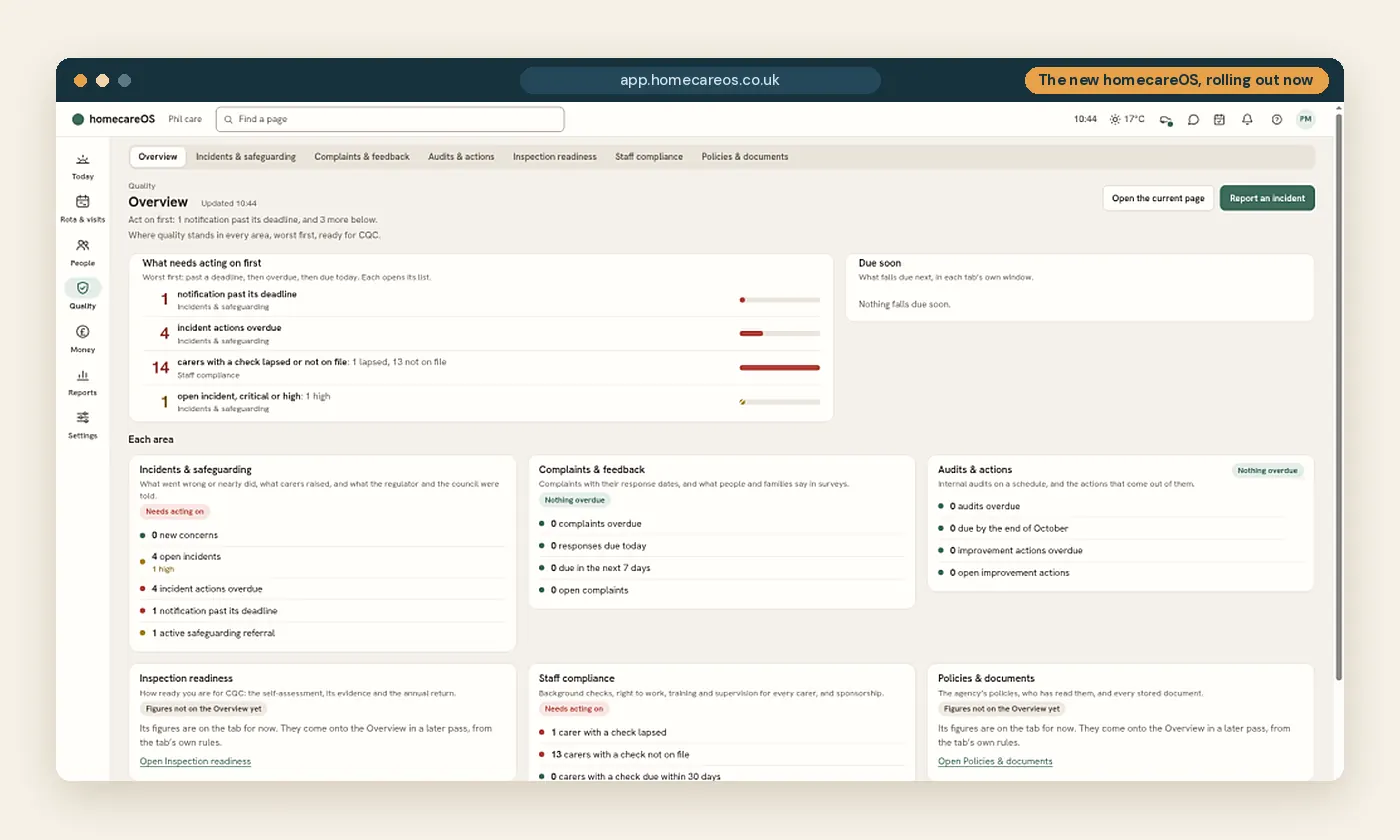
The notification tells CQC. The agency still needs the account of what happened, who was told, and what was done next. Incident records in homecareOS hold the incident, the follow-up actions and the safeguarding timeline. That is a description of the product on that page. It does not decide whether Regulation 16 or 18 is met, and it does not submit the CQC form. Those remain with the registered person.
Sources
- Notifications: guidance for providers, Care Quality Commission, updated 20 May 2025, for the offence of failing to notify, who must submit, delegation, the provider portal and Word forms, medicines errors, and what may be used to identify a person.
- Notifications, Care Quality Commission, for the list of events and registration changes.
- Regulation 12 and Schedule 3, Care Quality Commission (Registration) Regulations 2009, for the statement of purpose and the 28-day notice of a revision.
- Regulation 14, for absence of 28 days or more, the contents of the notice, and the return to duty.
- Regulation 15, for notice of changes to who carries on or manages the activity, officers, the nominated individual and insolvency.
- Regulation 16, for the death of a service user.
- Regulation 18, for serious injury, abuse, police incidents, events that threaten the service, and deprivation of liberty outcomes.
- Regulation 25, for the offence.
- Schedule 5, Health and Social Care Act 2008 (Regulated Activities) Regulations 2014, for the fixed penalty amounts.
- Regulation 14, Regulation 15, Regulation 16 and Regulation 18, Care Quality Commission, for the intention of each regulation, the injury examples, and prosecution without a warning notice.
- Death of a person using the service, serious injury, allegations of abuse, police involvement and events that stop a service running safely, Care Quality Commission, for how each notification is submitted.
- Absence of a registered individual for 28 days or more and return after that absence, Care Quality Commission, for the form and the email route.
- Registered manager for an activity, Care Quality Commission, updated 6 August 2024, for the notice and the manager's own application.
- Changes to your statement of purpose, Care Quality Commission, updated 11 March 2024.
- Notifiable diseases and how to report them, GOV.UK, and regulation 2 of the Health Protection (Notification) Regulations 2010, for the duty on a registered medical practitioner.
- Incidents, audits and compliance records, for how homecareOS stores an incident and its follow-up. That page describes the product.