Digital Care Records Where Every Change Leaves a Trail
Care planning software for UK domiciliary agencies, with person-centred digital care records and complete audit trails. Dynamic care plans, electronic MAR, body maps, observations and outcome-focused goals, all linked to every visit, accessible from anywhere.
The record an inspector can trust, because nobody can edit it
Filing cabinets overflowing with paper care plans. Illegible handwriting on MAR charts. Hours wasted searching for the right file before an inspection. Sound familiar? homecareOS replaces it all with structured, searchable, real-time digital records that carers actually want to use, and regulators love to see.
A week of medication, at a glance
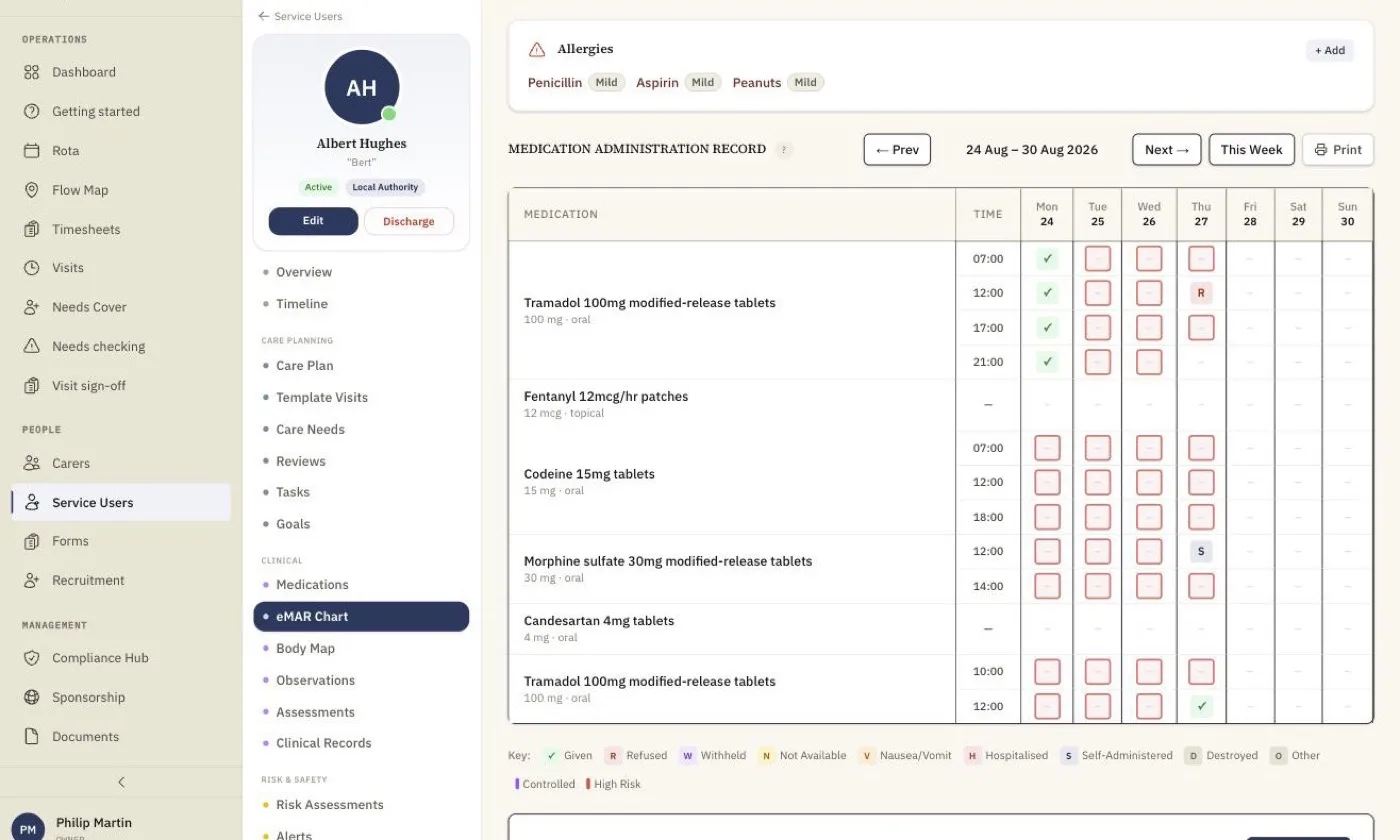
Every dose that was due, and what actually happened on the day. Given, refused, or simply not due.
- Mon
- Tue
- Wed
- Thu
- Fri
- Sat
- Sun
- Given
- Refused
- Not due that day
A care plan that stays joined up
A care plan is only useful if the rest of the record points back at it. Risks belong to a section of the plan, and goals are measured by the people doing the visits rather than reviewed once a year.
A risk finds the part of the plan it belongs to
- A new risk assessment
- Linked to its care plan section
- No clean match, left for a person to place
Record a falls risk and the plan's mobility section is offered without being asked for. Nutrition and choking both point at nutrition, fire safety and hazardous substances both point at the environment section, and eighteen risk categories are mapped this way.
The part worth noticing is what happens when there is no clean answer. Safeguarding, lone working and financial abuse map to nothing, and a suggestion is never made if that section does not exist on this particular plan. The risk is left unlinked for a coordinator to place, or not, rather than filed somewhere tidy and wrong.
Goals measured at the visit, not at the review
- Progress recorded by a carer at a visit
- Recorded from the office
- Reached one hundred, marked achieved
Every update on a goal is a record in its own right, carrying the visit it came from, who wrote it and what they said. So a goal is not a percentage somebody adjusted before a review meeting, it is a trail of moments with names and dates against them, and when it reaches one hundred it is marked achieved with the date it happened.
That matters for anyone who has had to evidence an outcome. The question is rarely whether the person improved, it is whether you can show when, and who saw it.
What your carers record, and what it proves
Every feature is designed to improve outcomes for service users while making life easier for carers and managers.
Person-Centred Care Plans
The plan follows your nation, not England with the labels swapped: an English plan is built on CQC’s quality statements, a Scottish one on the Care Inspectorate’s themes. Risks, goals and medicines all link back to the section of the plan they belong to.
Electronic MAR (eMAR)
Nine outcome codes, not three. Refused and withheld are recorded as different events, because the person declining a dose and the carer deciding not to give it are clinically different things, and most systems collapse them into one. Controlled drugs and high-risk medicines carry their own flags and a witness field.
Body Map Documentation
Tap the site on a body map and record what you found: bruising, redness, swelling, a skin tear, or where a patch went on. A patch record cannot be saved without a site, because rotation is the thing that gets audited.
Outcome-Focused Goals
Goals carry a baseline, a measure and a review date, and progress is recorded at the visit rather than remembered at the review. They link to the care plan section they serve, so an outcome has somewhere to sit.
A Trail Behind Every Change
A medication record or care note can be corrected, but only one way: the correction needs a written reason, and the original wording, who changed it and when are kept in a history nobody can alter. A carer's visit note can never be deleted, so what was written at the door is always there to show an inspector.
Observation Tracking
Ten observation types, from fluid and food intake to repositioning, mood, sleep and seizures. Anything outside the expected range raises an alert with an acknowledgement trail, so a rising temperature is chased rather than filed.
Turn a Conversation Into a Care Plan
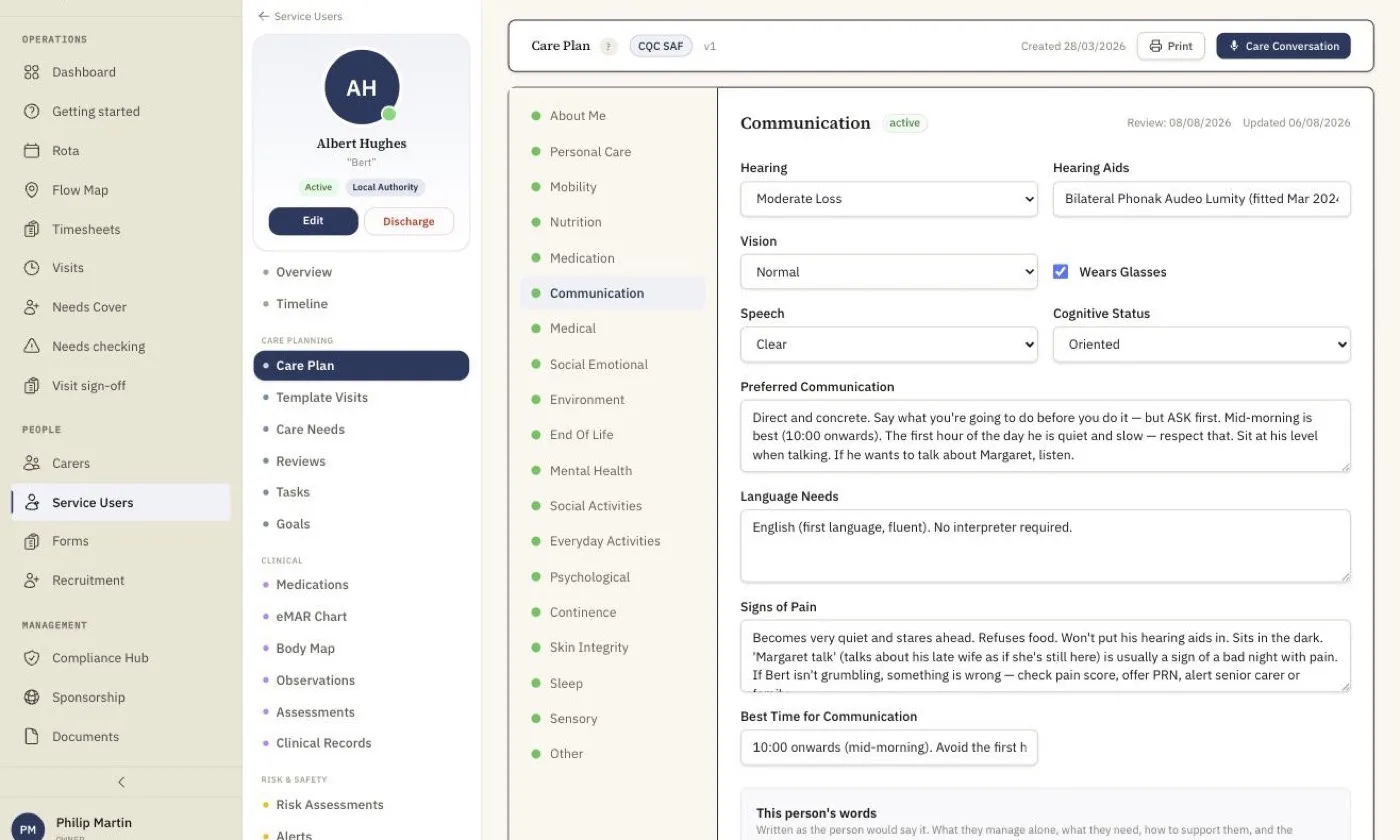
Sit with the person and their family and simply talk, section by section. homecareOS records each part of the conversation, transcribes it, and drafts structured, person-centred care-plan content from what was actually said. You review and approve every section before anything reaches the plan, so the person's own words shape their care and your team keeps clinical judgement where it belongs. Available on the Pro plan.
Record the assessment section by section, as a natural conversation
Automatic transcription of what the person and their family actually said
AI drafts structured, person-centred care-plan content from the transcript
Review, edit and approve every section before it reaches the care plan
The person's own words shape the plan, not notes typed up hours later
Runs in the browser on a phone or tablet, for the manager or coordinator doing the assessment
The recording and its transcript are kept alongside the approved text, with who reviewed it and when
A Week of Medication, One Clear Chart
The eMAR chart shows every scheduled medication round across the week at a glance. Given, refused, withheld and not available each carry their own outcome code, and a round that was due but never recorded is flagged in red on the chart, so managers can spot a pattern before it becomes a problem. Every entry is timestamped and attributed for a complete audit trail.
Everything a home care record has to hold
Everything you need to document, monitor, and evidence outstanding care, all included as standard.
Why immutability is the whole point of a digital care record
Any system can store a care note. The question an inspector is really asking is whether it could have been changed after the fact, so ask any system you are considering to show you the full history of a corrected record. Our guide to domiciliary care management systems lists the other questions worth putting to them.
Moving from paper to electronic medication records is linked to fewer administration errors in systematic reviews and real UK care-home data, the evidence base behind our eMAR.
See the evidence →Digital care records: your questions answered
What a digital social care record is, whether notes can be changed after the fact, and what families and inspectors get to see.
Start recording care digitally this week, free
Set your agency up in under fifteen minutes and have your carers recording on their phones the same week. Free for your first five carers, no card, and your records export whenever you want them.
Related Features
Compare homecareOS to your current software
See how we stack up against every major UK home care platform, feature by feature, transparent pricing, no fluff.