Care staff management software
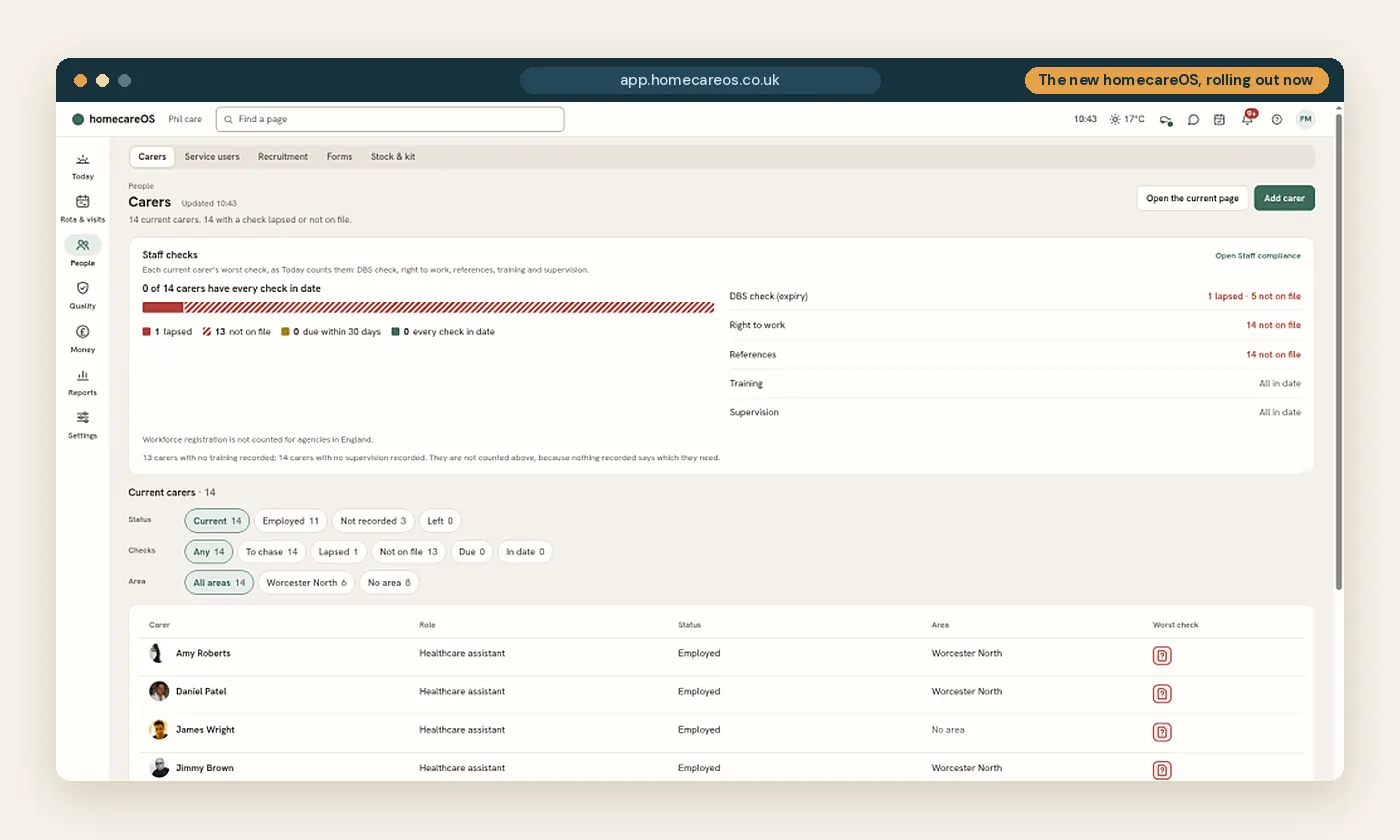
Comprehensive staff management for UK domiciliary teams, training and background check tracking, Bradford Factor scoring, supervisions and leave management. Everything you need to develop, support and keep your best carers.
Your Carers Are Your Greatest Asset. Treat Them That Way.
Retaining good carers is the single biggest challenge in home care. High turnover drives up costs, disrupts continuity of care, and shows up at your next inspection, whichever of the four nations you are registered in. homecareOS gives you the tools to track training, score absence with the Bradford Factor, manage leave and schedule supervisions, so the patterns surface before your best people walk out the door. Hiring the replacements, and building the staff file that has to exist before a new carer works alone, is the recruitment side of the same record.
The Bradford Factor, at a glance
Short, frequent absences push the score up the dial. Every carer is scored from their sickness spells over the last twelve months, without a separate HR system.
Tools That Help You Retain and Develop Your Team
Training Tracking
Monitor mandatory and specialist training across your entire team. Certificates are flagged as expiring from 30 days out, and as expired once the date passes.
DBS & Registration Monitoring
Track DBS checks, professional registrations (SCW, SSSC, NISCC) with renewal dates and document storage.
Bradford Factor Scoring
Automatic absence pattern analysis. S² × D calculation, scored on every carer record and banded on the rota as green under 100, amber to 199, red at 200 and above.
Leave Management
Holiday requests, approval workflows, and approved leave that lands straight on the rota. Carers can request leave directly from the mobile app.
Supervision Scheduling
Plan and record 1-to-1 supervisions, annual appraisals, and competency assessments. Overdue and upcoming reviews show in red and amber on the carer record and the staff compliance screen.
Absence Cover
Record a sickness absence or approve a leave request and scheduled visits that carer was down for are released back to the rota as needing cover, so nothing sits quietly unallocated.
Complete Staff Lifecycle Management
Comprehensive carer profiles
Multi-branch and multi-site management
Training record management
Mandatory training expiry flagged on the dashboard
DBS check tracking and renewals
Professional registration monitoring
Bradford Factor calculation
Approved leave shown on the rota
Leave request and approval workflow
Sickness absence recording
Supervision and appraisal scheduling
Competency assessment tracking
Absence and sickness trend reporting
The Real Cost of Staff Turnover
Sources: Skills for Care, The state of the adult social care sector and workforce in England, 2025 (turnover and vacancy, England, CQC-regulated non-residential services). The £3,600 replacement cost is Skills for Care's 2021 estimate, covering cover during the gap, advertising, hiring, induction and lost productivity.
Staff Management, Answered
Bradford Factor scoring, training expiry, and which background check and register apply in your nation.
Start Supporting Your Team Today
Give your carers the support they deserve and reduce turnover with the tools built into every homecareOS account. No extra cost. No add-ons.
Related Features
Compare homecareOS to your current software
See how we stack up against every major UK home care platform, feature by feature, transparent pricing, no fluff.
The Bradford Factor has genuine predictive validity as an early-warning signal, and workforce research points to the very drivers we surface, the evidence behind our absence and retention tools.
See the evidence →