A DBS check for care workers is the criminal record check a home care agency uses before someone goes into another person's house. The Disclosure and Barring Service sets the level from the tasks, not from the words on the job advert. Its leaflet on adult social care roles, updated on 17 September 2026, covers England, Wales, the Channel Islands and the Isle of Man. Scotland and Northern Ireland use different services, which are at the end of this guide.
The same leaflet is eligibility guidance. It says a worker can be asked to apply. It does not, by itself, say every employer in the country must apply. A registered home care agency is in a tighter position, because Regulation 19 and Schedule 3 tell you which documents have to be available for each person you employ, and CQC's guidance says that Schedule 3 information must be confirmed before they start.
Which DBS check for care workers
Personal care is regulated activity with adults. DBS says a care worker who does any of the following, for an adult who needs it because of age, illness or disability, can be asked to apply for an enhanced DBS check with an adults' barred list check. It does not matter whether the work is in the person's own home, a care home, a hospital or sheltered housing. Doing it once is enough. There is no "three times a month" test for this list.
The activities are:
- physically assisting the adult with eating, drinking, going to the toilet, washing, dressing, oral care, or care of the skin, hair or nails
- prompting the adult to do any of those things, because they cannot decide to do them, and then supervising them while they do
- training, instructing, or giving advice or guidance on how to do those things
Haircuts and nail treatments count only when they are needed to keep the person healthy and safe. A cosmetic visit does not.
Prompting someone to take medication is not, on its own, in that list. In the DBS scenarios that mention medication, the worker is also prompting or providing personal care. If the visit is medicines and nothing else, read the role against the leaflet rather than assuming the barred list applies. If the visit includes washing, dressing, continence care or the prompting-and-supervising test above, it does.
Anyone responsible for the regular day-to-day management of workers doing that care is in regulated activity as well, and is eligible for the same enhanced check with the adults' barred list, even if they do not provide the care themselves. A registered manager who manages those workers day to day is in that group. So is a coordinator whose job is that management. An administrator who never manages the care is not eligible merely because they work in the office. Describe the actual duties to whoever countersigns the application.
When the work is not personal care
Domiciliary work that is not personal care can still be eligible for an enhanced check without the barred list. DBS gives the example of a home help who tidies, cleans, does the laundry and cooks, so that adults can keep living in their own homes, and who does not provide personal care. That worker is eligible for the enhanced check without the adults' barred list.
The frequency test for that lower check is on the same page. The work has to be advice, assistance or instruction, given because of the adult's age, illness or disability, in the person's home, and it has to be done on more than three days in a 30-day period, or once overnight between 2am and 6am, or at least once a week on an ongoing basis.
Driving can change the level again. DBS says that transporting an adult, on behalf of an organisation, to or from somewhere they receive healthcare, social work or personal care, because they cannot get there themselves, is regulated activity. A taxi driver is specifically excluded from that. If your carers drive people to appointments as part of the job, say so in the job description you send with the application. A check requested for "care worker" may not have been assessed against the driving.
Ask only for the level the role is eligible for. DBS's eligibility collection says the recruiting organisation decides, and that a standard or enhanced check can be applied for only where the role is covered by the legislation. A barred list check on a housework role that is not regulated activity is not available. If you are not a registered body, an umbrella body submits the application and is responsible for the level it sends. You still have to tell them what the person will actually do. The eligibility tool is the place to test a job description that does not match the examples.
What has to be true before they start
Two offences sit underneath the paperwork. Under section 7 of the Safeguarding Vulnerable Groups Act 2006, a person commits an offence if they seek, offer or engage in regulated activity they are barred from. Under section 9, a person commits an offence if they permit someone to engage in regulated activity they know, or have reason to believe, that person is barred from, and the person then does the work. The enhanced check with the barred list is how you see that information. Failing to look is not the wording of either offence. Permitting someone to do the work when you know, or have reason to believe, they are barred is.
For a CQC-registered agency, Schedule 3 is the employment file. Where an enhanced certificate is required for a prescribed purpose, the schedule says the file must hold a copy of that certificate together with the suitability information relating to children or vulnerable adults. CQC's guidance on Regulation 19 says the Schedule 3 information must be confirmed before the person is employed. The same guidance says CQC cannot prosecute for a breach of Regulation 19, and that it can take regulatory action. It also says CQC must refuse registration if a provider cannot satisfy CQC that they can and will comply.
"Person employed" is wider than the payroll. CQC says it includes a volunteer, a contractor, and agency or bank staff, because of the broad meaning of employment in the regulations. If the agency or the umbrella body did the check, you still have to assure yourself that it is complete and satisfactory. A certificate for a different workforce, or an enhanced certificate that did not include the barred list, is not the check this role needs.
The rest of Schedule 3 is easy to treat as admin and then fail an inspection on. Alongside the certificate, the file needs proof of identity including a recent photograph, a full employment history with a written explanation of any gaps, and, so far as reasonably practicable, satisfactory verification of why a previous job working with children or vulnerable adults ended. It also needs satisfactory evidence of conduct in previous health or social care employment, and documentary evidence of any qualification relevant to the duties. CQC's recruitment policy guidance expects the policy to show the stages, including identity, references and the DBS check, and how you check why previous employment ended. The full employment history requirement does not apply to volunteers, except where the volunteer is a provider, a director or a registered manager.
Health information is on the list too: satisfactory information about any physical or mental health conditions relevant to the person's capability, after reasonable adjustments, to do the tasks that are intrinsic to the job. CQC says the interview and the checks have to meet the Equality Act 2010 on pre-employment health questions. A long-term condition or a disability is not, by itself, a reason to refuse the job.
Right to work is a separate check. The sponsor licence guide covers that file for agencies that sponsor workers.
Adult First is not the certificate
DBS offers Adult First for organisations that need a check of the adults' barred list before the full certificate comes back. Its employer guidance, updated for the October 2026 fee change, lists the Adult First fee as £6 and the enhanced check with a barred list as £41. Those are DBS fees, not a software price, and the page is the one to re-read when they change.
Adult First has three conditions on that page. The position must require a criminal record check by law. It must be eligible for the adults' barred list. And the organisation must already have requested the barred list check on the DBS application. Do not use it for a housework role that is not eligible for the barred list.
The reply is one of two sentences. "No match exists for this person on the current adults' barred list" means no match on that list. It does not mean the criminal record is clear, and DBS says the reply is only the first part of the check. A person can be permitted to start, under supervision, on the strength of that reply. "Registered body must wait for the DBS certificate" means you wait. The details may have matched the barred list, and DBS still has to confirm it.
The Update Service does not watch it for you
There is no official expiry date on a criminal record check. DBS says the information was accurate at the time of issue, and that you use the date of issue to decide whether to ask for a newer one. In some sectors a fresh check is required periodically. DBS does not set that period for home care.
The Update Service lets the worker keep a standard or enhanced certificate subscribed, and lets an employer run a free status check online. It is not available for a basic check. The worker has to join within 30 days of the certificate being issued. A reprint does not start that window again. The employer guide, updated on 5 October 2026, says the subscription is £15 a year and free for volunteers. An employer can pay, with the worker's permission. Paying does not give you the right to manage the subscription. It belongs to the worker.
A status check is not continuous monitoring. DBS searches weekly for new conviction information and for a new barred list entry, and every nine months for non-conviction information, which the police then decide whether to disclose. DBS will not tell you if the status changes. You have to look, with the worker's consent. The guide says there is no prescribed frequency. You set a risk-based schedule and you keep to it. A certificate in a drawer, subscribed and never checked, does not tell you anything new.
Before you run the check you have to be able to say yes to the conditions on that page. You have seen the original paper certificate. A copy, or a certificate held up on a video call, is not enough. You have checked the person's identity using the DBS identity rules. You have their consent. You are legally entitled to the same level, for the same workforce. The certificate's workforce is the adult workforce, or child and adult, and not "other" and not children only. If you are entitled to the barred list, the original certificate has to show that the barred list was requested. Some enhanced certificates show that it was not.
The result that matters most is the one that says the certificate is no longer current and that you should apply for a new check. The status check does not show you the new information. You only see it on a new certificate. The other results mean either that the original was blank and nothing new has been identified, or that the original disclosed information and nothing new has been identified since. You still have to have read the original.
If the person leaves, moves to a role you could not legally check at that level, or withdraws consent, you stop. The guide says that carrying on is breaking the law, because you are asking for data you are not entitled to see.
What to keep, and what not to pass on
DBS's employer guidance says certificate information should be destroyed after a suitable period, usually no longer than six months. Its sample handling policy says the same thing in the disposal section, and then adds a point that matters for this sector: organisations inspected by CQC, Ofsted or CSSIW may be legally entitled to retain the certificate for inspection. The page still uses the name CSSIW. The sample policy also says you must not keep a photocopy or any copy of the contents once the retention period has elapsed, but that you may keep the date of issue, the person's name, the type of certificate, the position it was requested for, the certificate number, and the recruitment decision.
That is a narrower record than a scan of the certificate in a shared drive. It is also the record that lets you run the next Update Service check. Put the decision in writing when the certificate disclosed something and you still offered the job. CQC's guidance on Regulation 19 says that if you consider a person suitable despite information in Schedule 3, your reasons should be recorded.
Certificate information may only be passed to people entitled to receive it in the course of their duties. The sample policy says it is a criminal offence to pass it to anyone who is not. A family member, and a colleague who is simply curious, are not on that list. If a commissioner asks for the contents of the certificate, check what you are allowed to share before you send a scan. The date, the level, the certificate number and the decision are the details the sample policy says you may keep.
If you receive Update Service information, or you are a registered body, you need a written policy on the recruitment of ex-offenders, available to applicants on request. DBS says it cannot dictate the wording. Its guidance says the policy should cover asking only for information you are legally entitled to, a risk assessment before you decide a standard or enhanced check is proportionate, and a statement on the application that a DBS check will be requested if the person is offered the job. The code of practice is the document registered bodies, and recipients of Update Service information, have to follow.
Scotland and Northern Ireland
Do not send a Scottish care-at-home worker through DBS and call it done. Disclosure Scotland's list of regulated roles in care includes carer and personal carer where the person has contact with protected adults. Its PVG scheme is the membership those roles use. A worker doing a regulated role in Scotland has to be in the PVG scheme even if they already hold a DBS certificate for the same sort of work. The cross-border guidance says that includes an organisation based elsewhere whose staff work in Scotland as a normal part of the role.
Northern Ireland uses AccessNI. The official starting point for employers is the AccessNI criminal record checks campaign page. A DBS certificate is not a substitute for the check AccessNI expects, any more than an AccessNI certificate is a substitute in England.
Recording the check without pretending it expires
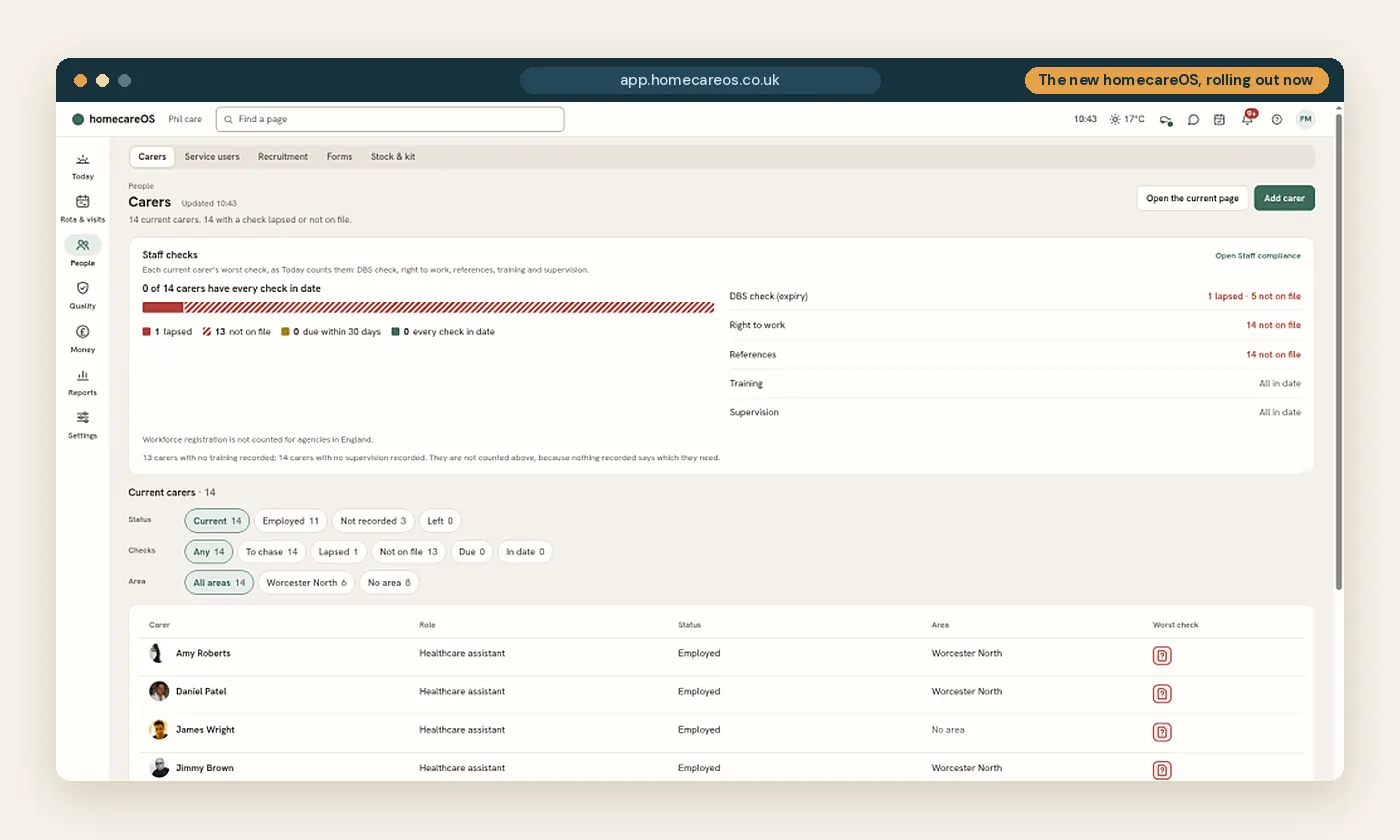
Staff records in homecareOS keep a renewal date and the document on the carer record, alongside training and the registration your nation uses. Recruitment treats the background check as a stage in hiring, labelled DBS, PVG or AccessNI. That is a place to put the certificate number, the date of issue, the level, whether the barred list was included, and the date you will run the next status check.
The software does not apply to DBS for you, and it does not log in to the Update Service. The date on the record is yours. DBS has already said the certificate itself does not expire. If the date you type is "three years from issue" because that is your policy, write the policy down. An inspector can ask why that interval, and the honest answer is that you chose it, not that DBS or CQC imposed it.
The hiring list this check belongs to, from the business plan through to the first client, is in how to start a home care agency in the UK.
Sources
- DBS checks for adult social care roles, Disclosure and Barring Service, updated 17 September 2026. Personal care, home help, managers and transport.
- DBS eligibility guidance, including the note that the eligibility legislation does not itself make checks mandatory, and the eligibility tool.
- DBS checks: guidance for employers. Fees after the October 2026 change, Adult First, the six-month handling rule, and the statement that a certificate has no official expiry date.
- DBS Update Service and the employer guide, updated 5 October 2026. Subscription, consent, original certificates, search frequency, and the status results.
- Handling of DBS certificate information, the sample policy on storage, inspection retention, and what you may keep after disposal.
- Recruitment of ex-offenders and the DBS code of practice.
- Regulation 19, Schedule 3, and CQC's guidance on Regulation 19.
- CQC recruitment policy and procedures.
- Section 7 and section 9 of the Safeguarding Vulnerable Groups Act 2006.
- Regulated roles in care, the PVG scheme, and PVG for work outside Scotland, Disclosure Scotland.
- AccessNI criminal record checks.
- homecareOS staff management and recruitment, for what the product stores.