
Ask any registered manager where their inspection anxiety concentrates and the answer is almost always the same: medication. It's the part of the service where a single missed or double-dosed administration can escalate into a hospital admission, a safeguarding referral and a regulator's notification within the same week. And it's the last major workflow in UK home care still commonly run on paper. eMAR, electronic Medication Administration Records, is the fix. This guide covers what it is, why paper fails, and what to demand from a modern medication management platform. For the wider picture of how eMAR fits alongside scheduling, care planning and compliance, see our complete guide to home care software in the UK.
What eMAR actually is
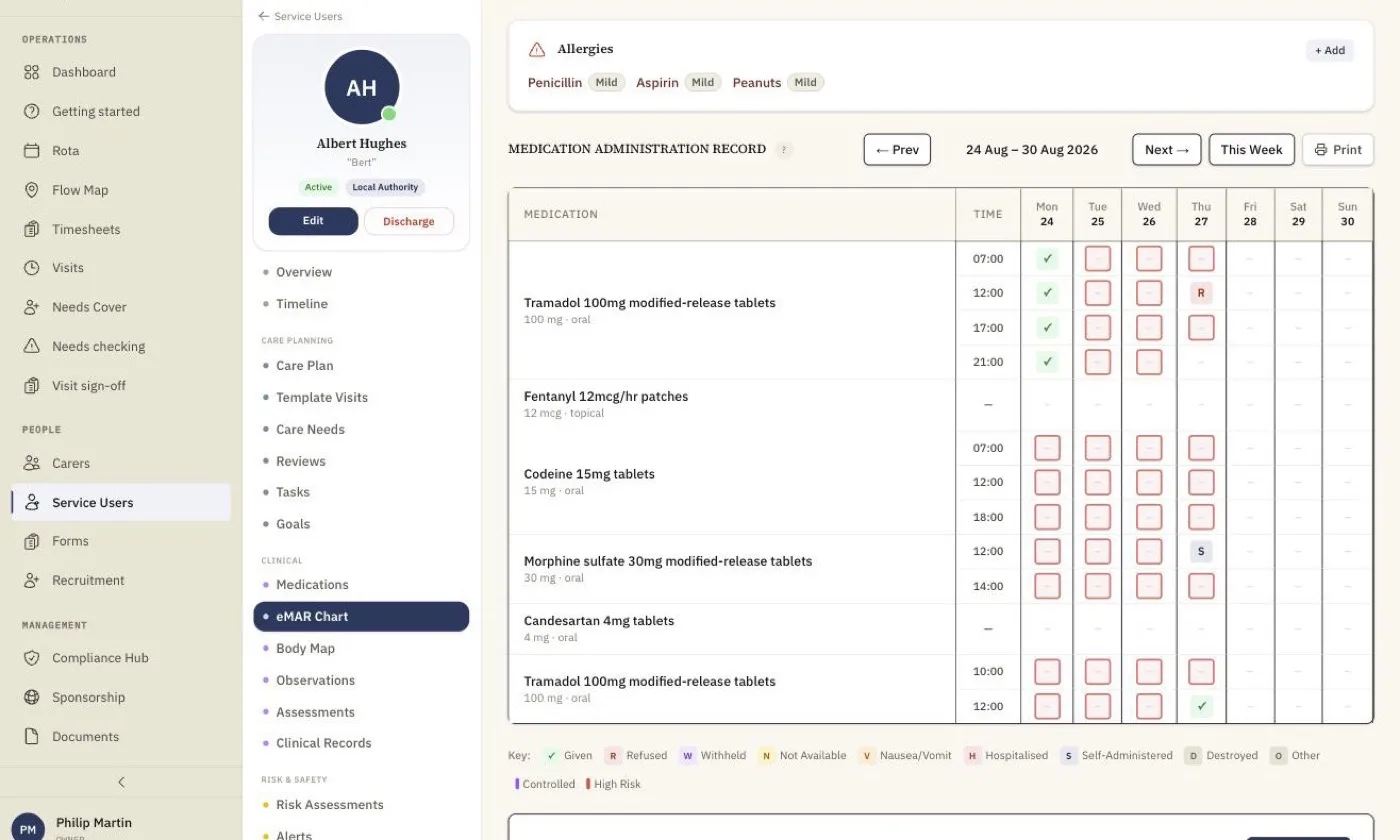
An eMAR replaces the printed MAR chart that sits in a service user's home with a digital medication record on the carer's phone. When a carer arrives for a visit, the app shows exactly which medicines are due, the drug, the dose, the route, the time window, and asks the carer to record the outcome of each one: given, refused, not required, or unavailable. The carer signs electronically, the entry is timestamped, and it syncs to the office in real time.
That last point is what separates electronic medication administration records from a scanned paper chart. On paper, the office is blind until the chart comes back, often weeks later, sometimes never. With eMAR, a coordinator can see medication compliance across every service user on a live dashboard, and an alert can fire the moment a scheduled medicine is overdue. The record is a by-product of the carer doing their normal round, not a separate administrative task bolted on afterwards.
Why paper MAR charts fail
Paper MAR charts fail in predictable, well-documented ways, and every home care manager has seen most of them:
- Missing signatures and gaps. A blank box on a paper MAR is ambiguous, was the medicine given and not signed, or not given at all? The chart can't tell you, and neither can the carer three weeks later.
- Illegible or retrospective entries. Signatures scrawled at the end of a shift, initials that can't be attributed to a named carer, times written from memory rather than at the point of administration.
- Transcription errors. Hand-copying a medication list from a pharmacy label or a GP letter onto a fresh MAR chart each cycle is one of the most reliable sources of medication error in the sector.
- No real-time oversight. The office finds out about a missed dose when the chart is collected, audited, or when something has already gone wrong.
- Reconciliation blind spots. When a prescription changes mid-cycle, the paper chart and the actual medicines in the home drift apart, and nobody notices until an audit.
None of these are exotic edge cases. They are the ordinary failure modes of paper, and they are exactly what an inspector is trained to look for.
Why eMAR matters for the "Safe" quality area, in every nation
In England, medication sits squarely inside the CQC Safe key question and its associated Quality Statements. Inspectors want evidence that medicines are managed safely, that errors are identified and learned from, and that the people receiving care are protected from avoidable harm. Our CQC compliance guide covers how that evidence is assessed in detail.
Crucially, this is not an England-only concern. Medication safety is a core expectation under every UK regulator, just framed differently: CIW in Wales inspects medication support under RISCA, with providers and staff accountable to Social Care Wales; the Care Inspectorate in Scotland assesses it against the Health and Social Care Standards, with staff registered with the SSSC; and RQIA in Northern Ireland examines it against its domiciliary care standards, with workers registered with NISCC. Whatever the regulator calls the quality area, the underlying question is identical, can you show that medicines were given correctly, that refusals and errors were recorded and acted on, and that someone was watching? eMAR answers that question with a timestamped, attributable, tamper-evident record instead of a folder of paper charts.
What a strong eMAR module includes
Not all eMAR is equal. A surface-level module will pass a quiet week and fail a serious incident. Here is what genuinely strong medication management software should do:
- Scheduled and PRN handled differently. Scheduled medicines appear at the visit they're due. PRN ("as required") medicines prompt the carer for the reason, dose and time, and then follow up on effectiveness at the next relevant visit. PRN without an effectiveness check is a recurring inspection finding.
- Controlled-drug double-sign. For controlled drugs, the workflow should require a witness or a second signature and record both, mirroring the accountability paper CD records demand.
- Refusal recording with reason codes. When a service user declines a medicine, the carer should record it against a structured reason code, not leave a blank box, so refusal patterns become visible rather than invisible.
- Photo capture of labels. Photographing the dispensing label at first administration ties the record to the actual medicine in the home and reduces transcription risk.
- Medication-error logging. A real eMAR assumes errors happen and gives you a structured way to record, categorise and act on them, feeding directly into your incident and learning process.
- MAR reconciliation. At the end of each cycle, the system should help you reconcile what was prescribed against what was administered, surfacing gaps before an auditor does.
- Real-time office oversight and missed-med alerts. A live dashboard showing compliance across every service user, with alerts when a scheduled medicine is overdue rather than after the fact.
- Offline capture. The medication round, signature and any refusal or PRN reason must be captured offline on the carer's phone and synced when signal returns, with no data loss if the app closes mid-visit.
How to evaluate an eMAR module
Don't score eMAR on a slide. Score it on a live walkthrough. The single most revealing test is to ask a vendor to demonstrate a controlled-drug administration end to end, what the carer sees, how the second signature is captured, and exactly what gets logged for audit. Then ask them to put a phone in aeroplane mode, record a full medication round including a refusal and a PRN with a reason, come back online, and show you the sync. If they can only describe it rather than show it, treat that as a yellow flag.
Two more questions separate strong products from weak ones. First: "Show me your missed-medication alert firing on the office dashboard." If the oversight is a report you run rather than an alert that reaches you, it isn't real-time. Second: "Walk me through MAR reconciliation when a prescription changes mid-cycle." That's where paper breaks down, and it's where a good digital care records platform proves its worth.
Integration with GP and pharmacy systems
The biggest single source of medication error in home care is transcription, a human copying a medication list from a label or letter into a fresh chart. Integration is how you remove that step. A number of UK eMAR products exchange data with dispensing pharmacies so a service user's medication list flows into the record automatically rather than being keyed in by hand. Direct GP-system integration is far less common in domiciliary care, and you should be sceptical of vendors who imply otherwise.
When you evaluate integration, get specific. Ask which named pharmacy partners the platform exchanges data with, whether the exchange is one-way or two-way, and, most importantly, what happens when a prescription changes mid-cycle. The elegance of the demo matters far less than how the system behaves the day a GP alters a dose and the medicines in the home no longer match the chart.
How homecareOS handles eMAR
eMAR in homecareOS lives inside the carer mobile app and the wider care records module, not as a paid add-on. Scheduled and PRN medicines are handled distinctly, with PRN effectiveness follow-up built into the flow; controlled drugs require a double-sign; refusals record against structured reason codes; and the whole round is captured offline and synced when signal returns. Because a medication record is never overwritten, and any correction needs a written reason with the original kept, every administration is an attributable, timestamped entry that feeds straight into the compliance dashboard and, where families opt in, into the family portal.
We'll be honest about the edges too: deep, certified pharmacy data exchange is an area the whole sector is still maturing, and it sits on our roadmap rather than being universally live today. eMAR also works best when it isn't treated in isolation, it belongs alongside the care plan it draws from, which is why it's worth reading our take on the future of digital care plans as the companion to this piece. Medicines don't exist on their own; they exist because a care plan says so, and the record is stronger when the two are joined up.
Continue reading
The Future of Digital Care Plans
Medicines flow from the care plan. Here's where person-centred, digital care planning is heading in UK domiciliary care.
Read more →Family Portal for Home Care
How a family portal turns medication and visit transparency into peace of mind, and fewer anxious phone calls.
Read more →The CQC Compliance Guide
Where medication safety fits in the Safe key question, and how to make inspection evidence a by-product of daily work.
Read more →eMAR in home care, answered
What is eMAR in home care?
eMAR stands for electronic Medication Administration Record. In domiciliary care it replaces the paper MAR chart with a record on the carer's phone. The carer sees which medicines are due at that visit, records each one as given, refused or not given with a reason, and signs with a timestamp. The entry reaches the office as it happens, so a coordinator can see medication across every service user without waiting for charts to come back at the end of the month.
Is eMAR a legal requirement for domiciliary care agencies?
No. No UK regulator mandates an electronic MAR, and you can run compliant medication support on paper. What is expected everywhere is an accurate, contemporaneous record: by CQC in England, by CIW in Wales under RISCA, by the Care Inspectorate in Scotland against the Health and Social Care Standards, and by RQIA in Northern Ireland. eMAR is not required. It removes the gaps, illegible signatures and missing charts that paper produces, which is a different argument and a better one.
What is the difference between scheduled and PRN medication on an eMAR?
Scheduled medicines are given at set times and recorded at the visit they are due. PRN, meaning as required, is given only when needed, such as pain relief. A good eMAR treats them differently: for a PRN it asks why it was given, the dose and the time, and then asks someone to record whether it worked. Recording a PRN with no effectiveness check is one of the most common medication findings at inspection.
Can carers record eMAR offline?
They have to be able to, or you will lose records. Home care happens in basement flats and rural blackspots, and any eMAR needing a live connection will drop entries. The homecareOS carer app holds the medication round, the signature and any refusal or PRN reason on the device and sends them when signal returns, along with the rest of the visit, so the carer finishes the visit properly and the phone deals with the rest.
Does eMAR software integrate with GP and pharmacy systems?
Some products exchange data with dispensing pharmacies so a medication list flows in rather than being typed, which removes a transcription step and the errors that come with it. Direct GP system integration is much less common in domiciliary care. When you are evaluating a platform, ask which pharmacies specifically, and ask what happens when a prescription changes mid-cycle, because that is where reconciliation problems appear.
See eMAR working inside homecareOS
The fastest way to judge an eMAR is to use one. Set up homecareOS with your own service users in about 10 minutes and record a medication round on the carer app, controlled-drug double-sign, PRN follow-up, offline capture and all. There's a free tier for agencies with up to 5 carers (no time limit), then transparent per-carer pricing as you grow, with the office team unmetered.