A workforce under strain: the scale of the problem
Any serious discussion of the future of home care has to begin with the people who provide it, because the sector's central problem is not a shortage of demand but a shortage of workers willing to stay. In its most recent annual assessment, Skills for Care estimated around 111,000 vacant posts in adult social care in England, equivalent to a vacancy rate of roughly 7%, about three times the rate seen across the wider economy (Skills for Care, 2025). A vacancy rate at that level is not a temporary blip to be recruited away; it is a structural feature of the labour market the sector operates in.
Turnover compounds the problem. The same data show churn concentrated among the youngest and newest workers: annual turnover of 44.6% among those under 25, and 39% among those with less than a year in post (Skills for Care, 2025). Provider-level analysis reaches a similar conclusion, with very high annual staff churn and a striking finding that it is better retention, not simply more hiring, that drives sustainable workforce growth; establishments in decline paradoxically report rising vacancies, evidence of the recruitment friction that constant re-hiring creates (Teo et al., 2022). For domiciliary agencies the human cost is felt as broken continuity: a service user who sees a different face each week, and a care plan whose subtleties never quite transfer between staff.
The international recruitment question and its limits
For a period after the introduction of the Health and Care Worker visa, international recruitment became the sector's principal source of new staff. That flow has since reversed sharply. Skills for Care records international recruitment into adult social care falling from around 105,000 in 2023/24 to roughly 50,000 in 2024/25, at the same time as the number of British-nationality workers fell by around 30,000 (Skills for Care, 2025). The macro picture is consistent: the Office for National Statistics provisionally estimated long-term net migration at 431,000 in the year ending December 2024, down almost half from 860,000, with Health and Care Worker visa grants falling steadily since late 2023 following visa restrictions (ONS, 2025).
Even at its peak, overseas recruitment was never a durable answer. The Nuffield Trust cautioned that international hiring cannot be a long-term fix unless the sector fixes retention, noting that around 30,000 domestic workers leave the sector each year and that pay at or below the national living wage, poor terms and precarious contracts remain the core barriers to a stable workforce (Oung, 2023). Qualitative research with care managers during the earlier Brexit transition reached a comparable verdict: alongside genuine anxiety about workforce supply, the underlying economics were decisive. Staff costs represent roughly 60% of costs in residential care and around 80% in domiciliary care, so a sustainable workforce depends on fair pay and conditions rather than on immigration policy alone (Read and Fenge, 2019).
The reversal in visa numbers should therefore be read less as a cause of the workforce crisis than as the removal of a temporary anaesthetic. For several years, agencies were able to fill vacancies without confronting the retention problem underneath; as that route narrows, the underlying churn re-emerges into full view. The lesson for the years ahead is that supply-side levers, however they are set, cannot compensate for a job too many people cannot afford to keep. A sustainable workforce has to be one that people join and then choose to stay in.
Pay, conditions and the economics of care work
Pay sits at the centre of the retention problem. The King's Fund reports median pay for an independent-sector care worker of about £12.00 an hour in March 2025, behind comparable roles in retail and the NHS, with more than half of home care workers on zero-hours contracts (The King's Fund, 2025). Low, insecure pay has predictable consequences for hardship: the Health Foundation finds a residential care worker is nearly twice as likely as the average UK worker to live in poverty, with around one in five residential care workers in poverty, and argues that targeted pay policy such as a sector minimum or defined pay scale is needed to change the picture (The Health Foundation, 2025).
These conditions are not the fault of individual agencies, most of which operate on thin margins set by local-authority fee rates. The structural cause is a funding settlement left unresolved for well over a decade. The independent Dilnot Commission judged the adult social care funding system "confusing, unfair and unsustainable" and recommended a lifetime cap on personal care costs; the fact that this question remains open continues to constrain what providers can pay their staff (Commission on Funding of Care and Support, 2011). Technology cannot repair a funding gap, and it is important to be honest about that at the outset. What technology can do is help an agency understand and protect its own margin so that more of every fee reaches the frontline, a theme explored further in our companion piece on funding the future of social care.
Why carers leave, and what makes them stay
Understanding retention requires looking beyond pay to the wider experience of the job, though pay remains the foundation. A rapid review of forty UK studies concluded that turnover is driven by low pay, poor conditions, low public esteem and a lack of progression, and that values-based recruitment, apprenticeships and clear career pathways show real promise for retention and professionalisation (Edwards et al., 2022). In other words, people leave not only because they are underpaid but because the role too often offers no visible future: no ladder from care worker to senior carer to team leader, no recognition of accumulated skill.
This points towards a more professionalised model for the years ahead: defined competency frameworks, portable qualifications, and the kind of career structure that has long existed in nursing. The prize is twofold. Professionalisation raises the status of care work, which the evidence identifies as a retention factor in its own right; and it gives carers a reason to build a career within an agency rather than treating the job as a way-station. Set against that ambition, the ordinary frictions of the job (unpredictable rotas, administrative overload, feeling unheard when things go wrong) take on outsized importance, because they are the daily texture that determines whether a carer stays long enough to progress.
It is worth noting that the concentration of turnover among the under-25s and those in their first year (Skills for Care, 2025) makes the early experience of the job decisive. A carer who feels supported, fairly scheduled and listened to in their first months is far more likely to become the experienced, continuity-providing worker every agency depends on. Retention, in this reading, is not a single intervention but the cumulative effect of many small decisions about how the workforce is treated day to day. The future of the care workforce is discussed more broadly in our series pillar, the future of UK home care.
The future: professionalisation, wellbeing and technology as augmentation
If pay and career structure are the foundations, technology is the layer that determines how much of a carer's day is spent on care rather than on paperwork. The distinction that matters is between technology as replacement and technology as augmentation. The evidence is instructive on both the promise and the risk. A national evaluation of digital social care records found that, where implemented well, they reduce time spent on paperwork and free staff for direct care (one provider estimated around 1,144 hours a year saved, worth roughly £6,700), but where suppliers are poorly chosen or roll-out is rushed, digital systems can instead leave carers with "less time for quality care" (Malley et al., 2026). The technology is not automatically benign; its value depends entirely on whether it removes burden or adds to it.
The augmentation model treats software as something that hands time back to carers and gives managers earlier, kinder signals about who might be struggling. Removing double-entry, replacing WhatsApp groups and paper timesheets, and making pay transparent are unglamorous changes, but they address precisely the administrative overload and sense of being unheard that the retention literature identifies. Wellbeing is not a poster in the office; it is whether a carer can see their earnings, request leave from their phone, and record a care note in ninety seconds rather than filling in a form at the end of a twelve-hour day. The trajectory the sector is on (more digital records, more mobile-first working, more data about workforce patterns) is only positive if it is designed around the carer's experience rather than the office's convenience.
How homecareOS is built for a workforce-first future
homecareOS was designed around the premise that retention is an operational discipline, not a slogan, and that the software an agency runs should make caring easier, not busier. Three parts of the platform speak directly to the workforce challenge described above.
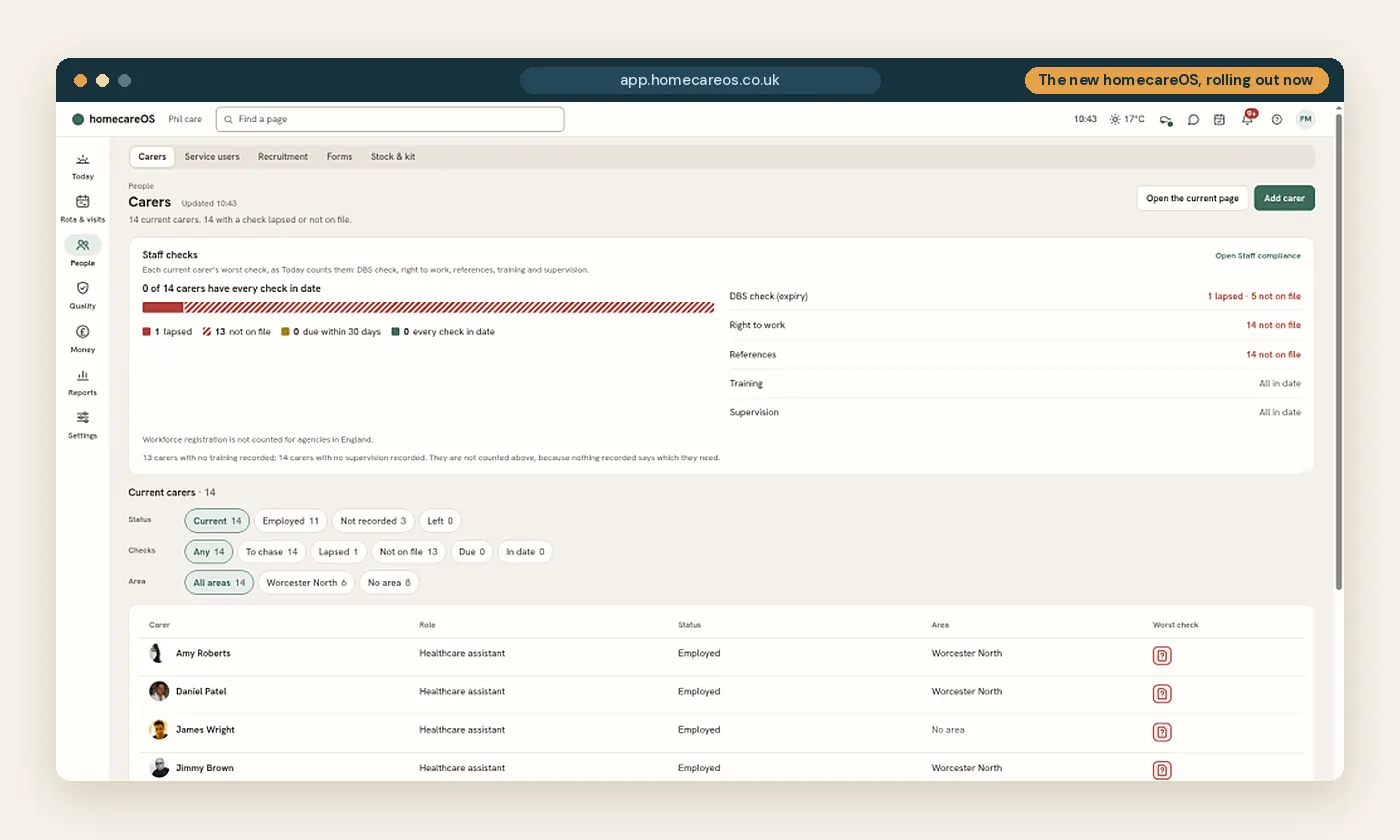
The first is early warning. homecareOS calculates the Bradford Factor for every carer (the S² × D formula that weights frequent short absences more heavily than a single long one), surfacing absence patterns before they become resignations. Combined with training-lapse and supervision signals in the staff management module, it gives registered managers a composite, humane read on which carers may need support. It is a signal to open a conversation, not a stick; used well, it is a retention tool rather than a disciplinary one.
The second is administrative relief. The offline-first carer mobile app lets staff check in with GPS verification, record care notes and medication administration, and request holidays from their phone, even in a basement flat with no signal, syncing when connectivity returns. Pay transparency, letting carers see projected earnings and mileage in real time, addresses the insecurity that the King's Fund and Health Foundation identify as central to hardship. The aim, set out in detail in our guide to cutting home care admin time, is simple: less time on forms, more time on care.
The third is honesty about the platform's own margin economics, which connects directly to pay. This reflects founder Philip Martin's MBA primary research, conducted with CQC-registered home care agency owners, which found that what an agency pays predicts its profitability better than what it charges. Staff pay, retention and travel-time economics, not headline rates, decide whether an agency is sustainable (Martin, 2026). homecareOS makes visit-level cost and margin visible precisely so that agencies can afford to pay well and see the return on doing so. You can read more about that research on the advisory page, and our guide to home care agency software sets out how the operational pieces fit together. The platform will not, and cannot, substitute for fair pay, but it can help an agency find the room to offer it.
The bottom line: technology serves people, not the reverse
The future of the care workforce will be decided first by pay and funding, and only then by technology. The evidence is unambiguous that low, insecure pay and the absence of a career path are what drive carers out (The King's Fund, 2025; Edwards et al., 2022), that international recruitment cannot substitute for retention (Oung, 2023), and that the sector's underlying funding question remains unresolved (Commission on Funding of Care and Support, 2011). No software product changes those facts, and any vendor who implies otherwise should be treated with suspicion.
What technology can do (the honest, worthwhile role) is augment the workforce: cut the administrative burden, give managers earlier signals about wellbeing and absence, make pay transparent, and hand time back so that carers spend it caring. Where digital records are chosen well and implemented with the carer in mind, they demonstrably free staff for direct care (Malley et al., 2026). That is the future homecareOS is built for: a workforce-first platform that supports the people delivering care, in full acknowledgement that it is fair reward, not clever software, that will ultimately keep them in the job.
References
- Commission on Funding of Care and Support (2011) Fairer Care Funding: The Report of the Commission on Funding of Care and Support (the Dilnot Report). London: HMSO. View source
- Edwards, D., Trigg, L., Carrier, J., Cooper, A., Csontos, J., Day, J., Gillen, E., Lewis, R. and Edwards, A. (2022) 'A rapid review of innovations for attraction, recruitment and retention of social care workers, and exploration of factors influencing turnover within the UK context', Journal of Long-Term Care, pp. 341-356. doi:10.31389/jltc.130. View source
- The Health Foundation (2025) Poverty, pay and the case for change in social care. London: The Health Foundation. View source
- The King's Fund (2025) The adult social care workforce in a nutshell. London: The King's Fund. View source
- Malley, J., Westwood, J., Snow, M. et al. (2026) A rapid evaluation of the implementation of Digital Social Care Records in England. Health and Social Care Delivery Research, 14(16). Southampton: National Institute for Health and Care Research. doi:10.3310/GJJW2821. View source
- Martin, P. (2026) Advisory: the research behind the advice. homecareOS / PsycheMeta Ltd. View source
- Office for National Statistics (2025) Long-term international migration, provisional: year ending December 2024. Newport: ONS, 22 May. View source
- Oung, C. (2023) Growth in social care workforce welcome but international recruitment not a long-term fix. London: Nuffield Trust, 12 October. View source
- Read, R. and Fenge, L.-A. (2019) 'What does Brexit mean for the UK social care workforce? Perspectives from the recruitment and retention frontline', Health & Social Care in the Community, 27(3), pp. 676-682. doi:10.1111/hsc.12684. View source
- Skills for Care (2025) The state of the adult social care sector and workforce in England 2025. Leeds: Skills for Care. View source
- Teo, H., Vadean, F. and Saloniki, E.-C. (2022) 'Recruitment, retention and employment growth in the long-term care sector in England', Frontiers in Public Health, 10:969098. doi:10.3389/fpubh.2022.969098. View source
Continue reading
Bradford Factor in Home Care
How the S² × D formula works, RAG thresholds, real-world examples, and how to use the score to support carers rather than punish them.
Read more →Cutting Home Care Admin Time
Where domiciliary agencies lose hours to paperwork and duplication, and the operational changes that hand time back to carers and coordinators.
Read more →Work with Philip Martin
Independent care-sector advisory grounded in MBA research on agency sustainability: pay, retention and the economics that keep a home care agency viable.
Read more →See homecareOS in action
A workforce-first platform for UK home care: Bradford Factor and wellbeing signals, an offline mobile app that cuts admin so carers spend more time caring, and four-nation compliance (CQC, CIW, Care Inspectorate, RQIA), with per-carer pricing that leaves your office team unmetered.