A home care worker's day is a chain of visits joined by time in the car, on foot, or on a bus. The National Minimum Wage is an hourly test, so those joining journeys are often the hours that decide whether the week's pay was enough. This is the rule for that test. It is not advice on a particular contract. The contract still matters, because it decides how you have agreed to pay, but it does not decide which hours the regulations count.
The practical version sits inside carer payroll: the pay run has to be built from time that actually happened, not from the rota alone. This article is the legal test that pay run has to survive.
The test is an average for the pay period
The National Minimum Wage applies even when nobody is paid a stated hourly rate. The Department for Business, Innovation, Science and Trade's guidance on calculating the minimum wage sets the check out as five steps. Work out which of the four types of work the person is doing. Identify the pay reference period, which is the period the payment covers and cannot be longer than a calendar month. Add up the pay that counts for that period, then the hours that count, and divide pay by hours. The result has to be at least the rate for that worker.
You must meet that rate in each pay reference period. The same guidance says you may pay more in one pay reference period to make up for paying less in the period immediately before, if the extra pay relates directly to the underpaid amount. One example it gives is hours you could not calculate in time for the payroll cut-off.
Hours on a timesheet count in the period in which they were worked. The guidance says you must pay for those hours in that pay reference period or the next one. If the timesheet arrives late, which the guidance defines as less than four working days before the end of the period after the work was done, it says a special rule in regulation 9(2)(c) of the National Minimum Wage Regulations 2015 applies. You then have until the end of the pay reference period after the one in which the timesheet was submitted. The pay still counts for the period in which the hours were worked.
Which kind of work the carer is doing
The hours that count depend on the type of work. The same guidance, in working hours for which the minimum wage must be paid, describes four types.
- Time work. Pay depends on the number of hours worked. A carer whose pay changes because one week has more visits than the next is, in the ordinary case, doing time work. The guidance says that anybody whose pay varies with the hours they work is likely to be performing time work.
- Salaried hours work. All of the conditions have to be met. There is a set number of basic hours in the year, an annual salary for those hours, and no other payment for the basic hours apart from that salary, a performance bonus or a salary premium. Pay is no more often than weekly and no less often than monthly, in equal instalments, or in monthly instalments that vary but come to the same amount each quarter. The guidance says that when HMRC investigates, it tests for salaried hours work first.
- Output work. All of the conditions have to be met. Pay depends only on the number of things made or tasks done, the worker is free to start and finish when they wish, and there is no set number of hours.
- Unmeasured work. The work fits none of the other three. The guidance's care example is a live-in carer paid a fixed sum for staying with a client for a 24-hour period, who can take a break whenever they are not needed. That is unmeasured work, because the pay does not vary with the time actually worked.
Most domiciliary rotas are time work. A coordinator on a salary for a set annual number of hours may not be. One contract can contain more than one type: basic hours as salaried hours work, and extra hours paid by the hour as time work. Get the type wrong and the rest of the calculation uses the wrong hours.
Journeys that count
For time work, regulation 34 of the National Minimum Wage Regulations 2015 treats as hours of time work the time a worker spends travelling for the purposes of that work, where they would otherwise be working. That includes hours spent travelling to carry out assignments at different places, between which the worker is obliged to travel, where those places are not occupied by the employer.
The department's working-hours guidance puts the same rule in plain language. Time spent travelling from one work assignment to another counts. Its example is a care worker driving from one client to another between appointments. Waiting for a train, or changing from one form of transport to another, in the course of work travel, also counts. A rest break taken during the journey does not.
GOV.UK's page on minimum wage for different types of work uses three care examples.
- Two appointments in the morning, and no break. The time at the appointments counts, and so does the travel between them.
- One appointment in the morning and one in the afternoon, with the worker going home in between. Travel from the first appointment home, and from home to the afternoon appointment, does not count. If the worker does not go home, and instead takes a break on the way to the next appointment, the travel counts and the break does not.
- A morning appointment, then work at the office, a 30-minute break, then an afternoon appointment. The appointments count, and so does the travel to and from the office. The break does not.
HMRC's manual on travelling time for time work says how an officer looks at the journey. The mode of transport is not the point. An officer will not accept a recalculation that pretends the worker took a different route, or a faster one. A computer-calculated planned route is not persuasive where it does not represent what happened, including the distance, the weather or traffic delays. Time spent waiting in traffic, or for a connection, is likely to be treated as time worked. It is not assumed to be a break. Time when the worker actually stops travelling in order to take a break is not travelling time.
Travel from a place of work to training counts, in both the working-hours guidance and the HMRC manual. The working-hours guidance says travel between the worker's home and the training venue generally does not.
Journeys that do not count for the minimum wage
Regulation 34 excludes travel between the worker's home, or a place where they are temporarily residing other than for work, and a place of work or a place where an assignment is carried out.
The working-hours guidance says the same thing twice, so that it is hard to miss. Travelling between home and work does not count, whether or not the worker has a fixed workplace, unless they are working during the journey itself. Travelling from home to a task or assignment will generally not count either. The page then says, in terms, that employers are not required under minimum wage legislation to pay the minimum wage for the journey between home and the first and last customer of the day.
That is the journey agency owners most often argue about, and the published rule is narrower than the argument. Home to the first visit, and the last visit home, fall outside the minimum wage hours. The visits, and the travel between them, do not.
Working time is a different question
The same paragraph of the working-hours guidance draws the line that gets these two regimes mixed up. The Court of Justice of the European Union has ruled that, for a worker with no fixed or habitual place of work, the journey between home and the first and last customer of the day is working time for the Working Time Directive. The guidance says pay is a separate question, governed by the contract and by minimum wage rules.
Acas makes the same split on its page about working time for someone who travels for their job. It names care workers as people who often have no fixed place of work, and says travel between home and work is likely to count as working time for them, because during that time they are classed as doing work for the employer. It then says that when travel counts as working time, what the worker is paid depends on the contract, and that the National Minimum Wage has its own rules on how working time affects the calculation.
So a journey can count towards the working time limits and still not be an hour you must include in the minimum wage sum. The reverse is not a safe assumption either. A contract that is silent does not, by itself, tell you the minimum wage answer. Read the regulations for the pay test, and the working time rules for the hours test.
Mileage, allowances and weekend rates
The hourly rate in the minimum wage sum is not "everything that landed in the bank, divided by the visit hours".
The calculating guidance starts from gross pay, before deductions, and then takes out elements that do not count. They include payments that reimburse a worker's expenses, allowances, and the premium element of overtime and shift pay. Tips do not count. Benefits in kind do not count, apart from the separate rules on living accommodation.
A repayment of money the worker spent on the job does not count as minimum wage pay. HMRC's manual on expenses paid to the worker uses the arithmetic: £100 of wages plus £10 to reimburse the week's expenses is £100 of National Minimum Wage pay, not £110. Calling the £10 an allowance does not change that, where it is a reimbursement of expenditure in connection with the employment. If the employer pays a round sum and only part of it was spent on the expense, only the part that was spent is taken out.
A mileage payment that pays the worker back for the cost of the journey is in that category. It is not pay for the minutes. The minutes still have to be in the hours, and the wages that count still have to cover them. A higher rate paid as wages for those minutes is different. That rate is pay. The reimbursement of the fuel is not.
Allowances more broadly do not count unless they are consolidated into standard pay or they relate to the worker's performance. The guidance's examples include unsocial hours, London weighting, special duties, punctuality and being on call. There is no statutory definition of "consolidated". The indications the guidance gives are that the allowance is treated like the rest of pay, for example in a pay rise, or that it is included in pensionable pay, or included when an overtime rate is calculated. Where a consolidated payment is still a premium for overtime or unsocial hours, that premium element may still not count.
For time work and output work, if you pay a higher rate than the basic rate for particular hours, the premium is the amount by which that higher rate exceeds the basic rate, and the premium does not count towards minimum wage pay. The basic rate for those hours does. The guidance says this does not apply to salaried hours work or unmeasured work. If instead you pay different basic rates for different duties, rather than a premium on the same job, the guidance says the whole of each rate can be included. A weekend rate can fall either side of that line. The difference is whether it is a premium on top of the rate for the same work, or a separate basic rate for different duties. The guidance sets out both treatments. It does not classify a particular agency's night rate for you.
Deductions have their own rules. A deduction for an expense actually incurred in connection with the employment reduces pay for minimum wage purposes. So does a payment the worker has to make to you, or to someone else, for that kind of expense, unless you reimburse it. Uniforms, which the guidance treats in their own section, are a common place this goes wrong. This article does not restate that section. If you take money off a carer for something they need in order to do the visits, read it before you assume the hourly rate is intact.
The rates from 1 April 2026
The rates change on 1 April each year. From 1 April 2026 they are the rates in the National Minimum Wage (Amendment) Regulations 2026, which amended the 2015 regulations. GOV.UK's rates page lists the same figures as the current rates.
| Rate | From 1 April 2026 |
|---|---|
| National Living Wage, aged 21 and over | £12.71 |
| Aged 18 to 20 | £10.85 |
| Under 18 | £8.00 |
| Apprentice | £8.00 |
The apprentice rate applies if the apprentice is under 19, or is 19 or over and in the first year of their apprenticeship. An apprentice aged 19 or over who has completed that first year is entitled to the rate for their age. The rates page gives the example: an apprentice aged 21 in the first year is entitled to £8 an hour, and after that first year to £12.71.
The increase does not cut through the middle of a pay reference period. The calculating guidance says the new rate applies to the first pay reference period that starts on or after the change. A period that starts on 16 March and runs to 15 April is still on the old rate. The period that starts on 16 April is on the new one.
Where the employer provides living accommodation, a separate accommodation offset applies. From 1 April 2026 the amount in those amendment regulations is £11.10 for each day accommodation is provided. That is not a travel rule. The conditions for using it are in the calculating guidance.
The records you have to be able to produce
Regulation 59 requires the employer to keep records sufficient to establish that the worker is being paid at least the national minimum wage. The records for one worker and one pay reference period have to be producible as a single document. They may be kept on a computer. They must be kept for six years, beginning with the day after the pay reference period that follows the one the records cover.
The department's enforcement guidance says it is your responsibility to prove you are meeting the requirement, and that failing to keep sufficient records is a criminal offence. So is failing to keep them for the required period. There is no prescribed form. The guidance recommends a consistent breakdown of working time and the pay rates across the pay reference period.
For a domiciliary worker, a sufficient record has to be capable of showing the things the calculation uses. Which visits were worked, and how long each one took. Which gaps were travel between assignments, which were a break, and which were a trip home. How long the travel actually took, rather than how long a clear-road plan said it would take. Which parts of the payment were wages, which were a reimbursement of expenses, and which were a premium that does not count. The rate that applied to that worker in that pay reference period.
The visit record is the other half of that. Electronic call monitoring is how you show who attended and when they arrived and left. The gap between one clock-out and the next clock-in is not, by itself, travel. It might be traffic, a break, or a return home. Someone has to say which, and the record has to keep that answer.
What the software can show, and what it cannot
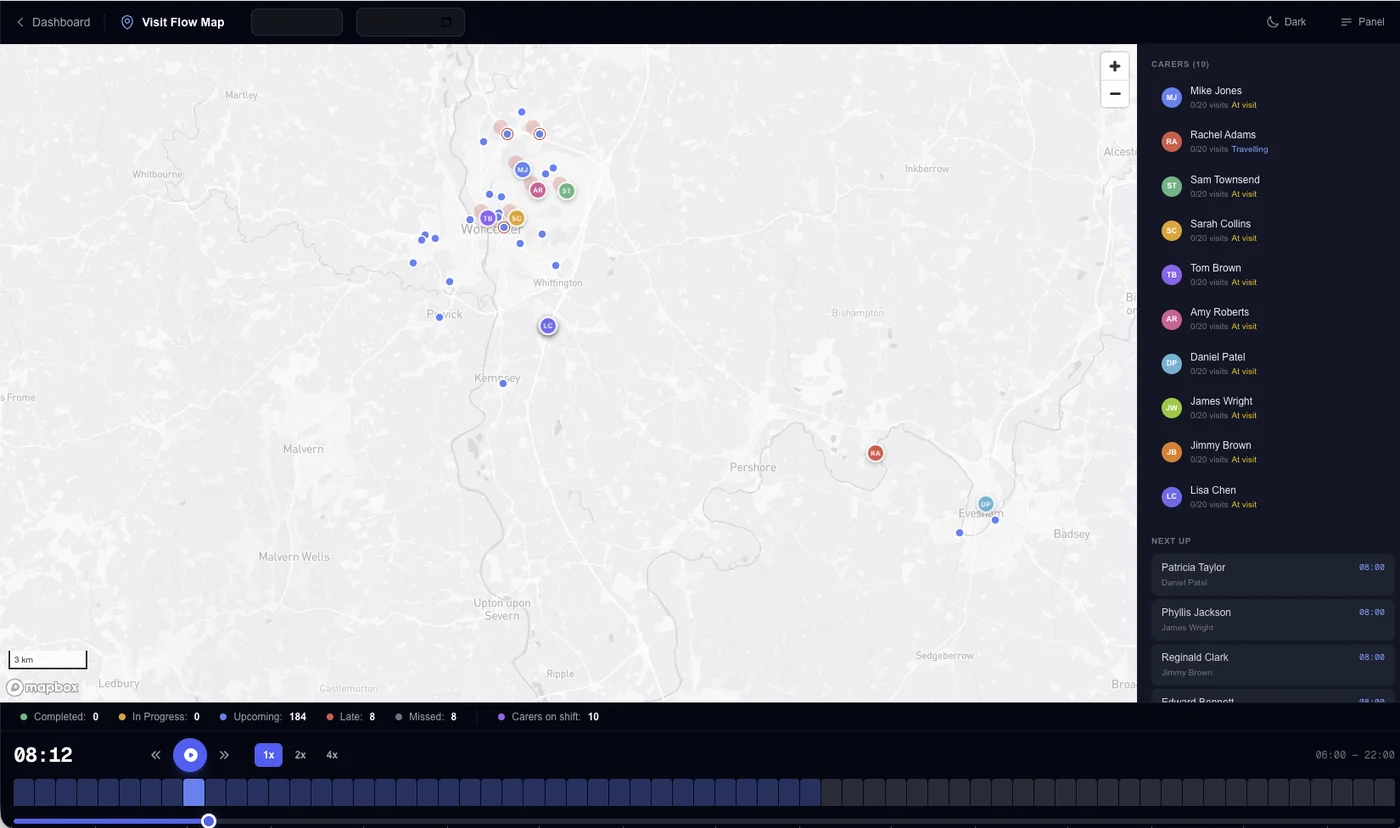
Billing and payroll in homecareOS keeps what you charge separate from what you pay. Planned time, actual time, paid time and charged time are recorded independently on each visit. Travel between consecutive visits is measured by road distance and logged from the visits the carer checked into. A manager approves or rejects each journey with the postcodes, the miles and a drive time already filled in, and an approved claim goes into the pay run.
Route planning puts a travel gap on the rota, so a run is not drawn as if the carer could be in two houses at once.
None of that is the minimum wage calculation. A drive time taken from the road network is a mileage and planning figure. HMRC's manual, cited above, says a computer-calculated route that does not reflect the journey that happened, including traffic, is not the figure an officer has to accept. The pay run still has to be checked in the way this article describes: hours that count, pay that counts, divided, for each pay reference period. homecareOS prepares that pay run. It does not file payroll with HMRC. The payroll guide says where that handoff sits.
If you want to see one carer's visits, the journeys between them and the pay run on one screen, book a 15-minute demo.
A check before the pay run is sent
The department's checklist for employers includes failure to pay for travelling time as one of the ways the minimum wage goes wrong. For a home care payroll, the check is specific.
- Name the type of work for each worker. Do not assume every carer and every coordinator are time work.
- For the pay reference period, list visit time and travel between assignments the worker was obliged to make. Leave out home to the first visit and the last visit home. Leave out breaks. Include time stuck in traffic.
- Use the time the journey took. Do not substitute a planned route that assumes a clear road.
- Start from gross pay. Take out expense reimbursements, allowances that are not consolidated into standard pay, and, for time work, the premium element of overtime or unsocial hours.
- Divide. Compare the result with the rate for that worker's age, using the rate in force for the pay reference period, not the rate that came in halfway through it.
- Keep the breakdown, in a form you can produce as one document for that worker and that period, for six years.
Sources
- Regulation 34 of the National Minimum Wage Regulations 2015, on travelling treated as hours of time work.
- Regulation 59 of the same regulations, on the records an employer must keep.
- The National Minimum Wage (Amendment) Regulations 2026, for the rates and the accommodation offset from 1 April 2026.
- National Minimum Wage and National Living Wage rates, GOV.UK, including who gets the apprentice rate.
- Calculating the minimum wage, Department for Business, Innovation, Science and Trade, on the pay reference period, what counts as pay, and timesheets. The guidance collection was updated on 6 January 2026.
- Working hours for which the minimum wage must be paid, on types of work, travel, and the difference between working time and pay.
- A checklist for employers, which includes failure to pay for travelling time.
- Minimum wage for different types of work, GOV.UK, for the three care-worker examples.
- Enforcing the minimum wage, on records and the offence of failing to keep them.
- NMWM08300, travelling time for time work, HMRC internal manual.
- NMWM09170, expenses paid to the worker, HMRC internal manual.
- Working time for someone who travels for their job, Acas.
- homecareOS billing and payroll, for the four-value time model and mileage claims. That page describes our product.