Technology in care is never neutral
It is tempting to think of software, sensors and monitoring devices as neutral instruments, tools that simply do what their users intend, no more and no less. In social care that assumption is mistaken. The design and deployment of assistive, monitoring and communications technologies for older and disabled people are ethically loaded rather than value-free: each design choice embeds a particular view of risk, of independence, and of whose preferences should prevail (Nuffield Council on Bioethics, 2023). A fall sensor that alerts a family member also tells that person when their relative last left the house. A visit-verification app that reassures a commissioner also records a carer's every movement. The same feature can protect dignity or diminish it, depending on how it is built and how it is governed.
This matters more in home care than almost anywhere else, because the setting is the person's own home. The pressures driving adoption are real and well documented: the adult social care workforce in England stands at roughly 1.7 million posts under persistent vacancy and turnover strain, with an estimated need for around 540,000 additional posts by 2040 (Skills for Care, 2025). Technology is frequently offered as part of the answer to that gap. But efficiency arguments should not be allowed to settle ethical questions by default. This essay works through the main tensions honestly, and treats none of them as solved. It forms part of our wider Future of Care series, which examines where domiciliary care is heading over the coming decade.
Monitoring in the home: safety against privacy and autonomy
The clearest ethical fault line runs through monitoring. GPS check-in, motion sensors, door alarms, bed occupancy pads and, increasingly, cameras can all keep a vulnerable person safer. They can also convert a home into an observed space. A large review of surveillance technologies in care for people with dementia and intellectual disabilities found a recurring, unresolved conflict between the resident's autonomy and the staff's duty of care, and warned that such technology risks marginalising and effectively controlling the very people it is meant to protect (Niemeijer et al., 2010). The device does not resolve the dilemma; it relocates it.
Nor is monitoring always the benign extension of independence it is marketed as. Ethnographic work on telecare, heavily promoted to enable ageing in place under budget pressure, found that it can shade into coercion where older people are given little genuine choice, and argued that the right to not use a device, and even to "misuse" it, must be respected if the technology is to remain a form of care rather than control (Mort et al., 2013). The lesson is not that monitoring is illegitimate, but that its legitimacy depends on the person's continuing, meaningful agreement.
Regulators have begun to codify this. In England, the Care Quality Commission's guidance on surveillance in care services requires that any monitoring be proportionate to a specific risk, that it minimise intrusion on privacy, that it preserve dignity (for example by never recording intimate personal care) and that it be accompanied by a data protection impact assessment (Care Quality Commission, n.d.). Those are useful tests wherever an agency operates, though the precise regulatory framework differs across the four nations. A philosophically grounded version of the same idea holds that assistive technology should be judged against a cluster of values: autonomy first, but also safety, enablement, independence, privacy and social connectedness. It acknowledges openly that these values can and do conflict, so that trade-offs must be reasoned through case by case rather than assumed away (Sorell and Draper, 2014).
Consent, capacity and the Mental Capacity Act
Everything above rests on consent, which is precisely where care technology becomes hardest, because many of the people it touches may have fluctuating or diminished capacity to give it. The Mental Capacity Act 2005 sets out the governing principles for England and Wales: a person must be assumed to have capacity unless it is established otherwise; they must be given all practicable support to make a decision before being treated as unable to; capacity is decision-specific rather than global; and where a person genuinely lacks capacity, any act done on their behalf must be in their best interests and must reflect their own past and present wishes, feelings, beliefs and values (Mental Capacity Act 2005).
Applied to technology, these principles are demanding. Installing a camera or a movement sensor is a specific decision that requires its own capacity assessment. A person may be perfectly able to consent to a medication reminder yet unable to weigh the implications of continuous video monitoring. Consent obtained once, at the point of installation, cannot be treated as permanent; wishes change, and a device the person now visibly resents is no longer consented to in any meaningful sense. Where capacity is lacking, "best interests" is not a licence for whatever is safest or cheapest: it requires a genuine attempt to reconstruct what this person would have wanted, which will sometimes mean accepting a degree of risk in favour of privacy and self-determination. Substituting a blanket policy ("all our clients have fall sensors") for that individualised judgement is an ethical shortcut the Act does not permit.
Care data is among the most sensitive data there is
Home care generates an extraordinarily intimate data trail: medication records, continence and mobility notes, mental health observations, body maps, safeguarding concerns, and the daily rhythm of a person's life. Under the UK GDPR most of this is special category health data, attracting the highest level of legal protection. The ethical weight of that data is proportionate to its sensitivity. A breach here is not an inconvenience; it can expose the most private facts of a person's existence, and, because service users are often dependent and sometimes cognitively impaired, the people affected are frequently least able to seek redress.
Good practice therefore reaches beyond mere legal compliance toward genuine data minimisation and purpose limitation: collecting only what care actually requires, retaining it only as long as necessary, and being transparent with people and families about what is held and why. Families, in particular, should see what they need to reassure themselves and no more, a point we return to below, and one reflected in our own privacy policy. The regulatory instruments here, such as the data protection impact assessment that surveillance guidance already demands (Care Quality Commission, n.d.), are worth treating not as paperwork but as a structured occasion to ask whether a given data flow is truly justified.
Algorithms, opacity and the risk of dehumanisation
As artificial intelligence enters care software (cover-finding, rota optimisation, risk scoring), a further set of concerns arises around automated decision-making. Three risks stand out. The first is bias: a model trained on historical data can quietly reproduce the inequities in that data, systematically disadvantaging particular carers or service users. The second is opacity: where the reasoning behind a recommendation cannot be inspected or explained, neither the person affected nor the professional accountable for the decision can properly challenge it. The third is dehumanisation: the subtle drift by which a number on a dashboard comes to stand in for a person, and a score is acted upon as though it were a judgement.
UK law offers a partial safeguard. Under the UK GDPR, solely automated decisions that have legal or similarly significant effects on a person are restricted, and where they are permitted they must carry safeguards including meaningful human involvement and a genuine right to contest the outcome (Information Commissioner's Office, n.d.). The ethical reading of that rule is stronger than its legal minimum: in care, the algorithm should inform a human judgement, never replace it. A retention-risk flag or a suggested cover carer is a prompt for a coordinator to think, not an instruction to obey. Designing systems so that a person always remains answerable for consequential decisions is both a legal requirement and a moral one.
Digital exclusion: who gets left behind
An ethics of care technology must also attend to those the technology cannot reach. Digital exclusion is heavily concentrated among exactly the population that domiciliary care serves. Around 2.3 million people aged 65 and over do not use the internet at all, and roughly 4.7 million lack the basic skills to use it safely, with exclusion falling hardest on older, poorer and disabled people (Age UK, 2025). A care model that assumes every service user or family member can operate an app risks widening an already stark inequality, offering the confident and connected a better service while quietly disadvantaging everyone else.
The point is sharpened by the analogue-to-digital telephone switchover. Roughly two million telecare users depend on devices (pendant alarms, fall detectors) that route through the old analogue network, and coordinated action is needed to protect them from device failure as the switchover completes toward 2027 (Department of Health and Social Care and Department for Science, Innovation and Technology, 2025). Here a technological change made for unrelated reasons places some of the most vulnerable people in the country at direct risk. The ethical obligation is to ensure that digital-first never becomes digital-only: analogue and human alternatives must persist for those who need them. We discuss the operational side of this transition in our piece on technology-enabled care and the analogue switch-off.
The human relationship, and why it must come first
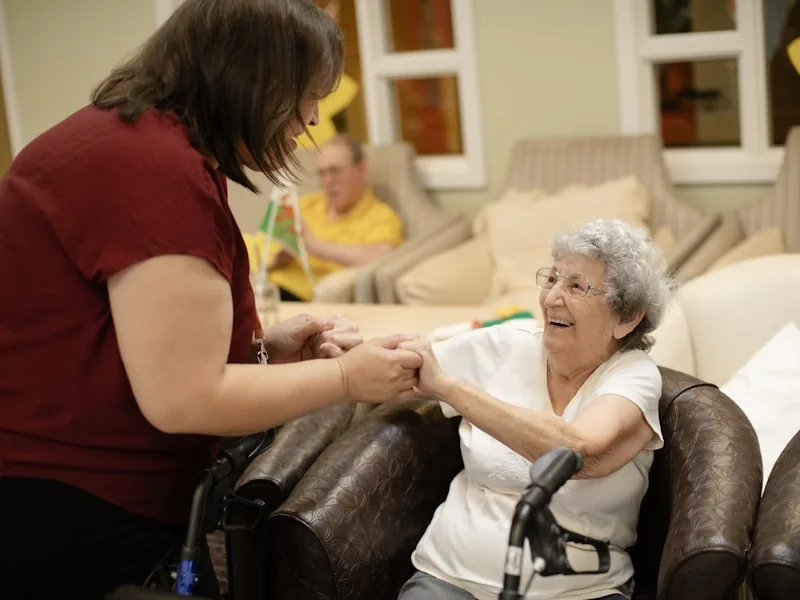
Beneath every specific tension lies a single question: what is care for? Home care is not simply the delivery of tasks; it is a relationship, and for many isolated people the carer at the door is the most significant human contact of their week. Technology that displaces that relationship in the name of efficiency risks hollowing out the thing it claims to support. The evidence points firmly toward augmentation rather than replacement. Digital technology in health and social care succeeds when it is co-developed with the workforce and with the people who draw on care, and when it supports staff rather than substituting for them. Human factors, in other words, matter at least as much as the devices themselves (The King's Fund, 2021).
This reframes the whole debate. The right measure of a care technology is not how much human contact it removes but how much it protects, by handing back to carers the hours that paperwork and phone-tag consume, and letting them spend that time with people. Preserving dignity is the constant thread: the person is never a data point, never merely monitored, never processed. Whether the workforce can be sustained to deliver that relational care at all is a related question we take up in our essay on the future of the care workforce.
How homecareOS approaches these principles
These commitments shape how homecareOS is built, and it is only honest to set out where the platform stands rather than claim the tensions above are dissolved. Three design choices matter most.
Consent-based family access. The family portal is designed so that families see visit confirmations, carer profiles and care summaries appropriate to their relationship, not the raw clinical record. Access is scoped to what a family member should see, reflecting the data-minimisation principle rather than defaulting to full disclosure. The intention is reassurance without surveillance of the service user's private life.
Human-centred, augmentation not replacement. The AI features (cover finder, rota builder, retention-risk scoring) are built as prompts for a coordinator's judgement, not as automated decision-makers. A ranked list of suitable carers still leaves the decision, and the accountability, with a person, consistent with the safeguards UK law expects around automated decisions (Information Commissioner's Office, n.d.). The offline-first carer app aims to give time back to carers on the visit, not to watch them.
Data protection by design. Care records are treated as immutable, with complete audit trails, database-level tenant isolation, and analytics designed to respect consent. The aim is to hold sensitive care data with the seriousness its special-category status demands. The research base behind these choices is set out on our evidence page, and our buyer's guide to domiciliary care software covers how to test claims like these when you are assessing platforms. None of this makes the ethical questions disappear (a well-designed tool can still be deployed badly), but the design intent is to keep the human relationship, and the person's dignity, at the centre.
Conclusion: keeping the ethics live
The ethics of care technology cannot be settled once and filed away. Each new sensor, portal and algorithm reopens the same questions in a slightly different form: whose safety, whose privacy, whose choice, and who remains answerable when a decision is made. The honest position is not that technology is good or bad for care, but that it is powerful, intimate and value-laden, and therefore demands continuous ethical attention rather than a one-time sign-off. The goal worth holding onto is modest to state and hard to achieve: technology that lets a carer spend more time being human with the person in front of them, and that treats that person, always, as an end in themselves rather than a case to be managed.
References
- Age UK (2025) Facts and figures about digital inclusion and older people (July 2025 briefing). London: Age UK. View source
- Care Quality Commission (n.d.) Using surveillance in your care service. View source
- Department of Health and Social Care and Department for Science, Innovation and Technology (2025) Telecare National Action Plan: protecting telecare users through the digital phone switchover. London: GOV.UK, 11 February. View source
- Information Commissioner's Office (n.d.) Automated decision-making, including profiling. View source
- Mental Capacity Act 2005, c. 9. View source
- Mort, M., Roberts, C. and Callen, B. (2013) 'Ageing with telecare: care or coercion in austerity?', Sociology of Health & Illness, 35(6), pp. 799-812. doi:10.1111/j.1467-9566.2012.01530.x. View source
- Niemeijer, A.R., Frederiks, B.J.M., Riphagen, I.I., Legemaate, J., Eefsting, J.A. and Hertogh, C.M.P.M. (2010) 'Ethical and practical concerns of surveillance technologies in residential care for people with dementia or intellectual disabilities: an overview of the literature', International Psychogeriatrics, 22(7), pp. 1129-1142. doi:10.1017/S1041610210000037. View source
- Nuffield Council on Bioethics (2023) The future of ageing: ethical considerations for research and innovation. London: Nuffield Council on Bioethics. View source
- Skills for Care (2025) The state of the adult social care sector and workforce in England 2025. Leeds: Skills for Care. View source
- Sorell, T. and Draper, H. (2014) 'Robot carers, ethics, and older people', Ethics and Information Technology, 16(3), pp. 183-195. doi:10.1007/s10676-014-9344-7. View source
- The King's Fund (2021) Shaping the future of digital technology in health and social care. London: The King's Fund. View source
Continue reading
The Future of UK Home Care
The pillar essay for our Future of Care series: the forces reshaping domiciliary care over the next decade, from workforce to technology to funding.
Read more →Family Portal
Consent-based family access: visit confirmations, carer profiles and care summaries scoped to what a family member should see, without surveilling private life.
Read more →The Research Behind homecareOS
The peer-reviewed evidence base underpinning our design decisions, covering monitoring, consent, data protection and the human relationship in care.
Read more →Care technology that keeps people first
homecareOS is built to onboard, schedule, invoice, pay and stay compliant across all four nations (CQC, CIW, Care Inspectorate, RQIA), with consent-based family access, human-centred AI that augments the carer, and data protection designed around the sensitivity of care records.