When a home care agency in England employs a care worker, safer recruitment is not optional. Regulation 19 of the Health and Social Care Act 2008 (Regulated Activities) Regulations 2014 is the fit and proper persons employed duty. Schedule 3 lists information required in respect of persons employed. CQC's guidance on Regulation 19 is the inspector's reading of that duty.
This checklist is for registered managers. It focuses on four items that often go missing or incomplete: right to work, DBS, references and a health questionnaire. It sits beside our longer guides on how to recruit care workers, applicant tracking and DBS checks. It is not legal advice, and it does not replace your recruitment policy.
1. Right to work
Before someone starts work, you must carry out a right to work check using an accepted method. The Home Office publishes an employer's guide to right to work checks and a practical page on checking a job applicant's right to work. The legal right to work in the UK page is the citizen-facing counterpart.
Checklist:
- [ ] You know which check method you will use (for example a manual document check, or an online share-code check where eligible).
- [ ] You have seen the original documents or completed the online check as the guidance requires, not a casual photo in a chat app.
- [ ] You have kept a clear copy or the online check result, with the date of the check.
- [ ] You know any expiry or follow-up date, and who will repeat a time-limited check.
- [ ] The check is filed against the person, ready for inspection.
A right to work check is separate from a DBS check. Passing one does not satisfy the other.
2. DBS
Most care worker roles that involve personal care in someone's home are eligible for an enhanced DBS check, often with a check of the adults' barred list where the work is regulated activity. You decide eligibility from the role. Use the DBS eligibility collection and the Find out which DBS check tool when the job description is unclear. The process for applicants is summarised on DBS checks: applicant guidance.
Checklist:
- [ ] The job description supports the level of check you are applying for.
- [ ] Identity documents for the DBS application match the person.
- [ ] You have a written position on starting work before the certificate arrives, with supervision if your policy allows any start at all.
- [ ] When the certificate arrives, you record the name, certificate number, type/level, issue date, whether the barred list was checked, and your recruitment decision.
- [ ] You know your retention rules. DBS guidance on handling certificate information, and CQC's inspection needs, both matter here; see our DBS guide.
- [ ] If you use the Update Service, you have consent and a diary for status checks.
3. References
Schedule 3 expects, so far as reasonably practicable, satisfactory evidence of conduct in previous employment concerned with the provision of services relating to health or social care, and satisfactory verification of why that employment ended. CQC's recruitment policy and procedures supporting document expects your policy to cover references and how you check why previous employment ended.
Checklist:
- [ ] You have asked for a full employment history, with written explanations for gaps.
- [ ] You have requested references that cover recent and relevant care employment, not only a friend.
- [ ] You have chased outstanding references before unsupervised work begins, in line with your policy.
- [ ] You have recorded whether each reference was satisfactory, and any follow-up questions you asked.
- [ ] Where a previous care employer will not reply, you have recorded what you did instead, so far as reasonably practicable.
- [ ] HomecareOS users: the apply portal collects two references as part of the applicant pack; still judge whether they meet Schedule 3 for that person's history.
4. Health questionnaire
Regulation 19 is concerned with whether the person can perform the work for which they are employed. Agencies usually gather that information through a health questionnaire appropriate to the role, then follow up where answers raise a concern. It is not a fishing exercise for irrelevant medical detail, and it is not a substitute for occupational health advice when you need it.
Checklist:
- [ ] The questionnaire is proportionate to the care worker role (moving and handling, lone working, infection risk, nights, and so on).
- [ ] It is completed before appointment, or before unsupervised work, as your policy requires.
- [ ] Someone competent reviews the answers; concerns are escalated, not filed unread.
- [ ] Reasonable adjustments are considered and recorded where relevant.
- [ ] The form sits on the staff file with the rest of the Schedule 3 information.
Put the four together before the first solo visit
A simple gate before unsupervised domiciliary work:
- Right to work complete and dated.
- Identity and photograph on file.
- Employment history with gaps explained.
- References satisfactory so far as reasonably practicable.
- DBS at the correct level seen and decision recorded (or a documented interim arrangement your policy allows).
- Health questionnaire reviewed.
- Induction and shadowing plan agreed, with mandatory training timed to the work.
That gate is easier to run when every applicant sits in one pipeline. Our applicant tracking guide covers why spreadsheets struggle here. Our staff file requirements guide covers what the four UK nations expect on the file after appointment.
How HomecareOS helps
In HomecareOS:
- The agency invites an applicant by email (SMS invites are not built).
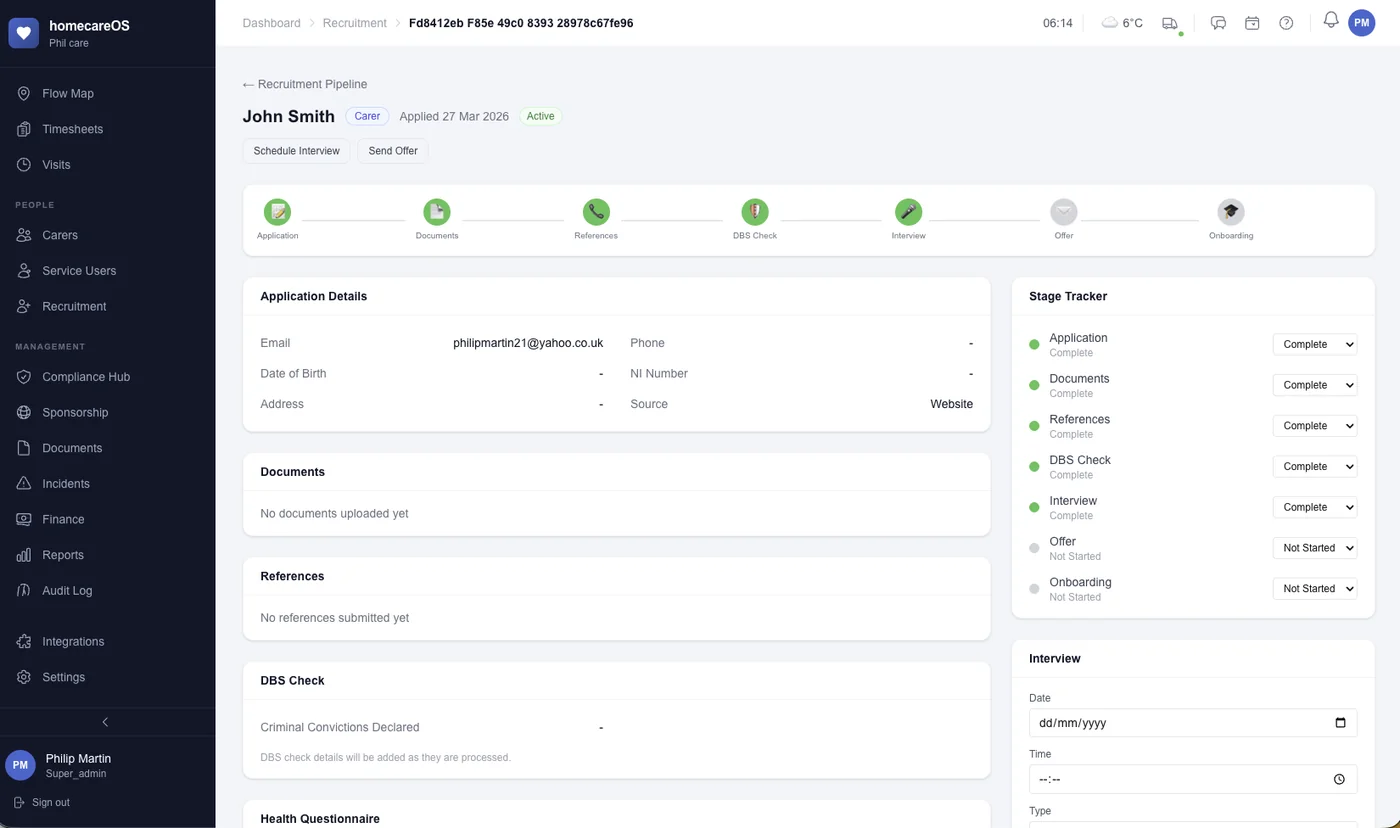
- The applicant completes /apply with their application, documents, right to work, two references, DBS details and a health questionnaire.
- The agency tracks them through seven stages: application, documents, references, DBS, interview, offer, onboarding.
- On hire, conversion creates a carer record ready to be added to the rota. It is not added automatically.
Agencies that sign up now get the recruitment portal £49 a month plus VAT. Open the recruitment portal offer, see recruitment features, book a 15-minute demo, or call Phil on 01905 674704.
Sources
- Regulation 19: Fit and proper persons employed and Schedule 3.
- CQC guidance on Regulation 19.
- CQC recruitment policy and procedures.
- Employer's guide to right to work checks, Check a job applicant's right to work, Legal right to work in the UK.
- DBS eligibility guidance, Find out which DBS check, DBS checks: guidance for applicants.
- HomecareOS recruitment and the portal landing page.