Medication management in home care means agreeing what help a person needs with their medicines, giving only that help, and recording it every time. In England, the guidance that sets this out for people in their own homes is NICE guideline NG67, Managing medicines for adults receiving social care in the community, published on 30 March 2017.
NG67 is not a regulation. The legal duties sit in the Health and Social Care Act 2008 (Regulated Activities) Regulations 2014, which CQC enforces. CQC's guidance on Regulation 12 tells providers to consult nationally recognised guidance about delivering safe care, and CQC's own medicines pages for home care repeatedly point back to NG67. In practice, NG67 is the standard your medicines policy will be read against.
This guide covers England. NICE guidance and CQC regulations are not written for Scotland, Wales or Northern Ireland, and how the four regulators differ is in home care compliance in the four UK nations. Use it alongside your own policy and, for clinical questions, the prescriber or pharmacist.
Who NG67 is for
NICE says NG67 covers medicines support for adults aged 18 and over who are receiving social care in the community. Its definition of a care worker includes home care workers and personal assistants, and it treats a person's own home as including extra care housing, Shared Lives living arrangements, sheltered and supported housing, and temporary accommodation. People living in residential or nursing care homes are covered by a separate NICE guideline.
The guideline uses the term medicines support for any support that enables a person to manage their medicines. CQC's page on medicines administration records puts that in practical terms: reminding people to take their medicines, helping them remove medicines from packaging, administering some or all of their medicines, and arranging supply, including ordering, collection or delivery.
NG67 also assumes the responsibilities have been agreed with NHS and local authority commissioners before support starts. It says commissioning and contractual arrangements need to be discussed, agreed and recorded as part of local care planning, so it is clear who is accountable and which provider delivers each part.
The medicines policy
Recommendation 1.1.2 says that when a social care provider has responsibilities for medicines support, it should have a documented medicines policy based on current legislation and best available evidence. NICE lists what it is likely to include, depending on the provider's responsibilities. Processes for:
- assessing a person's medicines support needs
- supporting people to take their medicines, including "when required", time-sensitive and over-the-counter medicines
- joint working with other health and social care providers
- sharing information about a person's medicines
- ensuring that records are accurate and up to date
- managing concerns about medicines, including medicines-related safeguarding incidents
- giving medicines without the person's knowledge (covert administration)
- ordering and supplying medicines
- transporting, storing and disposing of medicines
- medicines-related staff training and assessment of competency
CQC's Regulation 12 guidance says policies should address supply and ordering, storage, dispensing and preparation, administration, disposal and recording. Its controlled drugs in home care page adds that the policy must include controlled drugs. The rest of this guide follows the NG67 headings, so it doubles as a checklist for that policy.
Assessing what support the person needs
NG67 starts from the person managing their own medicines where they can. Recommendation 1.2.2 says not to take responsibility for managing a person's medicines unless the overall assessment shows the need to, and it has been agreed under local governance arrangements.
The assessment is part of the person's overall assessment of needs. NICE says to engage with the person, and their family or carers if the person agrees, and to take into account their needs and preferences, their understanding of why they take each medicine, what they can do themselves (such as reading labels, using inhalers or applying creams), how they currently order, store and take their medicines, any problems taking them, and who to contact about their medicines.
What goes in the care plan
Recommendation 1.2.5 lists what to record in the provider's care plan when a person needs medicines support:
- the person's needs and preferences
- their expectations for confidentiality and advance care planning
- how consent for decisions about medicines will be sought
- who to contact about their medicines
- what support is needed for each medicine
- how the support will be given
- who is responsible for providing it, particularly when more than one provider is involved
- when the support will be reviewed, for example after 6 weeks
NICE says to review the support at that time, or sooner if circumstances change, giving examples such as a change to the medicines regimen, a concern being raised, a hospital admission, or a life event such as a bereavement.
CQC's page on medicines care plans, last updated on 5 August 2025, adds that a good plan is person-centred, co-produced, reviewed regularly, condition-specific and accessible. It mentions details such as whether the person likes to take tablets with water, all together or one at a time, and says the plan must record any communication needs, such as large print, braille or spoken information.
Care workers then stay inside that plan. Recommendation 1.7.2 says they should only provide the medicines support that has been agreed and documented in it.
Telling the GP and pharmacy
Recommendation 1.3.1 says social care providers should notify the person's general practice and supplying pharmacy when they start providing medicines support, including who to contact about the person's medicines. This is also statement 2 of the NICE quality standard on the same topic, QS171, published in July 2018.
It is a small step that is easy to miss at the start of a package, so it is worth adding to whatever checklist your team uses when a new person starts.
Changes that arrive by phone
When a prescriber changes a medicine verbally to avoid a delay, NICE says they should give written confirmation as soon as possible. Recommendation 1.4.6 says the provider should have a process for handling verbal changes, including:
- recording the requested change, who requested it, the date and time, and who received it
- reading the recorded information back to the prescriber, including spelling the name of the medicine
- where possible, asking the prescriber to repeat the request to someone else, such as the person or a family member
Giving medicines on the call
Recommendation 1.7.1 says providers should have processes for care workers supporting people to take medicines, built on the 6 rights of administration: right person, right medicine, right route, right dose, right time, and the person's right to decline. The same recommendation covers what to do if the person is eating or asleep, or away for a short time, how to give specific formulations such as patches, creams, inhalers, eye drops and liquids, using the right equipment, and giving time-sensitive or "when required" medicines.
Several of the recommendations that follow describe what happens at the door:
- Authority and competence (1.7.5). Give a medicine only when there is authorisation and clear instructions, such as the dispensing label, the 6 rights have been met, and the care worker is trained and assessed as competent to give it.
- Check first (1.7.6). Ask the person whether they have already taken the dose and check the written records before giving it.
- Ask before opening (1.7.7). Ask whether the person is ready before removing a medicine from its packaging, unless something else is agreed in the care plan.
- From the original container (1.7.8). Give medicines directly from the container they are supplied in, and do not leave doses out for later unless that has been agreed after a risk assessment and recorded in the care plan.
- If the person declines (1.7.9). Consider waiting a short while before offering again, and ask about other reasons, such as pain or discomfort.
- Time-sensitive medicines (1.7.12). Make sure care workers can prioritise visits for people who need support with time-sensitive medicines.
That last point is a rota question as much as a clinical one. If a time-sensitive dose has no call booked near the time it is due, the plan cannot be met however well the care worker is trained.
Records: the MAR
Recommendation 1.5.2 says care workers must record the medicines support given for each individual medicine on every occasion, in line with Regulation 17, covering prescribed and over-the-counter medicines. That includes reminding, giving, and whether the person took or declined the medicine. NICE says they should use a medicines administration record (MAR), ideally printed by the supplying pharmacist, dispensing doctor or provider.
NICE lists what a MAR should include: the person's name, date of birth and any other identifier such as their NHS number, the name, formulation and strength of each medicine, how often or when it is taken, the route, the GP practice, any stop or review date, and additional information such as specific instructions and known allergies.
CQC's MAR page, last updated on 4 November 2025, adds detail for home care:
- There is no standard format, but the record should show who administered each medicine and whether the person took or declined it.
- Records should be legible, signed, dated and timed, completed as soon as possible after the medicine is taken, and should record refusals as well as doses taken.
- When a family member gives a medicine outside call times, agree with the person and family how it will be recorded.
- When a community nurse administers a medicine, agree how that will be visible to care workers, so doses are not duplicated.
- If a person manages their own medicines, the care plan should say so, with a risk assessment, and individual doses do not need recording.
- If a medicine is given from a multi-compartment compliance aid, keep an accurate, dated record of which medicines it contains.
- If a medicine changes mid-cycle, make a new entry so it is clear when it changed.
- Keep medicines administration records for adults for at least 8 years after the person's care with the service ended.
Recommendation 1.5.4 says changes to a MAR should only be made and checked by people trained and assessed as competent to do so. Whatever format you use, the test is whether someone can see later what was given, by whom, and why an entry changed.
Concerns, errors and safeguarding
Recommendation 1.6.4 lists concerns a care worker should raise with the provider, including the person declining a medicine, medicines not taken as prescribed, possible side effects (including falls after a change in medicines), stockpiling, errors or near misses, possible misuse or diversion, the person's capacity to make decisions about their medicines, and changes in their physical or mental health.
NICE says providers must have processes for medicines-related safeguarding incidents, in line with Regulation 13, and should have processes for reporting, reviewing and learning from medicines-related problems that support a "fair blame" culture, defined as treating mistakes as an opportunity to learn. Providers should review problems over time to spot trends, and make sure people, families and care workers know how to report side effects through the MHRA Yellow Card scheme.
Some medicines incidents will also need a notification to CQC, and some will trigger the duty of candour. Those thresholds are set out in CQC notifications for home care agencies and duty of candour for home care agencies.
Covert medicines
Covert administration is giving medicines in a disguised form without the person's knowledge or consent. NG67 says care workers must not give, or decide to give, medicines covertly unless there is clear authorisation and instructions in the care plan, in line with the Mental Capacity Act 2005. The process should set out who assesses capacity for the specific decision, seeking the prescriber's advice on alternatives such as stopping the medicine, a best interests meeting, how the decision is recorded and who can see it, pharmacist advice on how to give it, training for care workers, and when the decision will be reviewed.
Ordering, storage and disposal
NICE says responsibility for ordering, transporting, storing and disposing of medicines usually stays with the person or their family. Where the agency takes any of it on, that should be agreed and recorded in the care plan.
If the agency orders medicines, Regulation 12 requires that the correct amounts are available when needed. NG67 says care workers should record what was ordered (name, strength and quantity) and when it arrived, check for discrepancies, and know what to do if there is one. The provider should not hand ordering to the pharmacy unless the person or family has asked for that.
For storage, NICE says to agree with the person how medicines are stored and whether secure storage, such as a lockable cupboard, is needed when they are at risk from unsecured access. Disposal of unwanted or out-of-date medicines is usually by return to a pharmacy, with a record of what was returned, by whom, when and to which pharmacy.
On controlled drugs, CQC says they belong to the person and there is no legal requirement to store them separately in the person's home unless the risk assessment shows a need, no requirement for a controlled drug cupboard or register there, and no legal requirement for a second member of staff to witness administration. It does say to keep detailed records for topical controlled drugs such as patches, including the site of application and how it is rotated, to risk-assess transport, and to know how to contact your NHS England controlled drugs accountable officer if there is a discrepancy.
Training and competence
Recommendation 1.11.1 says that when a provider is responsible for medicines support, care workers should receive appropriate training and support, have the necessary knowledge and skills, be assessed as competent for the support they are asked to give, including through direct observation, and have an annual review of their knowledge, skills and competencies.
Where a medicine needs specific skills, such as giving it through a PEG tube, NG67 says a health professional should only delegate that task to a care worker when it has been agreed locally, the person has consented, responsibilities are recorded, and the care worker is trained and assessed as competent.
A short checklist for registered managers
- A written medicines policy that covers each NG67 heading above, including controlled drugs.
- A medicines section in every care plan that says, medicine by medicine, what support is given, by whom, and when it will be reviewed.
- A step in your new-package checklist to tell the GP and pharmacy that support has started.
- A process for verbal changes, with read-back.
- Calls booked so time-sensitive medicines can be given on time.
- A MAR that records every occasion of support, including declined doses, with changes made only by competent staff.
- A route for care workers to raise concerns, and a regular review of medicines incidents for trends.
- Training records showing competency assessed by observation and reviewed every year.
Where software fits
Software does not decide what support a person needs, and it does not replace the prescriber, the pharmacist or the competency assessment. It can make the record easier to keep and easier to check.
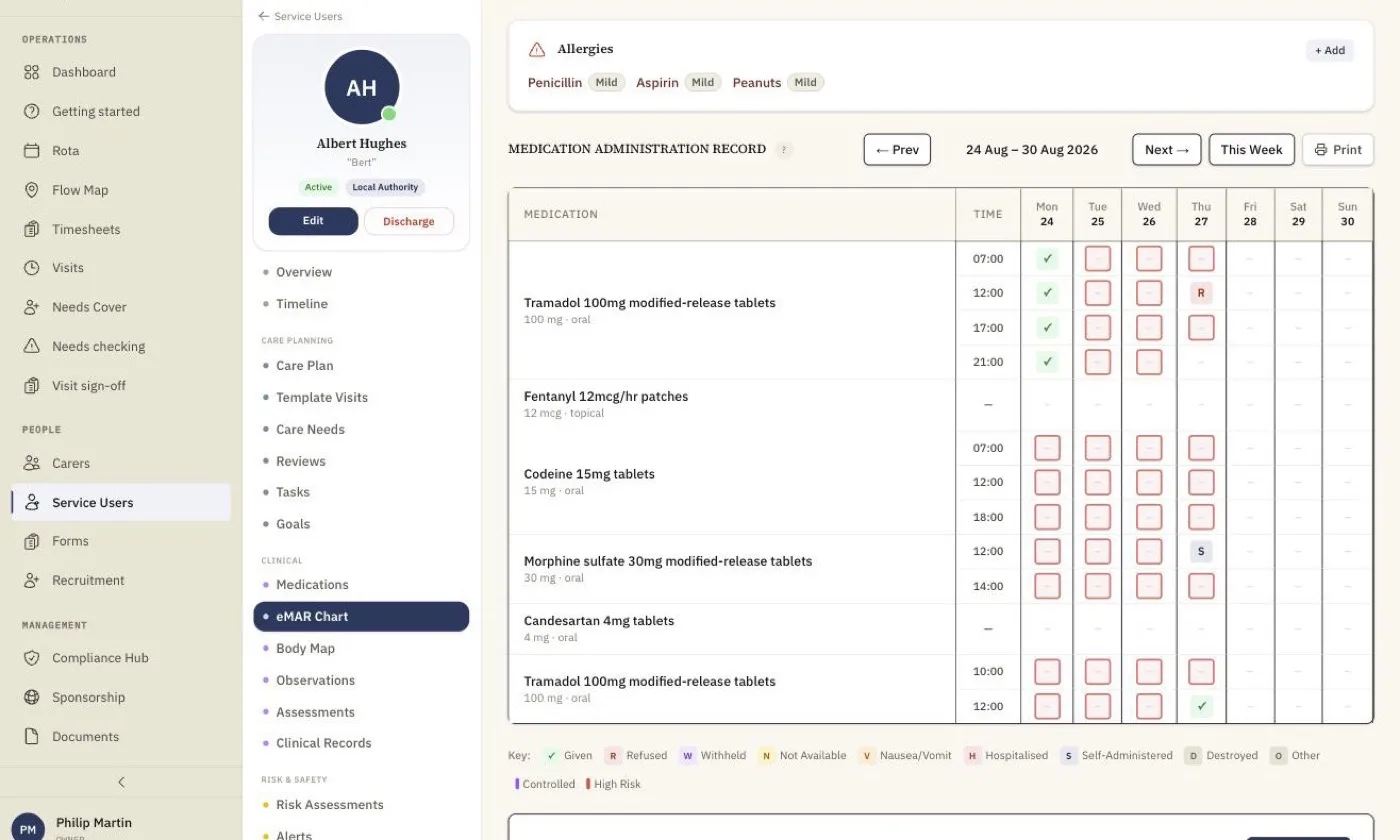
In homecareOS, the eMAR shows a carer the doses due within the call they are on, with the person's allergies on the same screen, and records each dose with an outcome code, keeping refused and withheld separate. The office sees a weekly chart where doses that were due but not recorded are flagged, and a check for medicines that no visit covers. A saved entry can be corrected, but the correction needs a written reason and the original is kept. Those are the features described on that page today. If you want to see them against your own rota, book a short demo or call 01905 674704.
Sources
- Managing medicines for adults receiving social care in the community (NG67), NICE, published 30 March 2017, for scope and publication date, and its recommendations for every numbered recommendation quoted above.
- Managing medicines for adults receiving social care in the community (QS171), NICE quality standard, published 24 July 2018, for the statement on informing the GP and pharmacy.
- Regulation 12: Safe care and treatment, Care Quality Commission, for the duty on safe management of medicines, sufficient quantities and what policies should address.
- Medicines care plans, Care Quality Commission, updated 5 August 2025.
- Medicines administration records in adult social care, Care Quality Commission, updated 4 November 2025, for home care recording, compliance aids and retention.
- Controlled drugs in home care, Care Quality Commission, updated 7 January 2025, for storage, witnessing and policy requirements.
- Yellow Card scheme, Medicines and Healthcare products Regulatory Agency, for reporting side effects.
- eMAR for home care, for how homecareOS records medicines. That page describes the product.