Why shift patterns matter so much in home care
Ask carers why they stay with an agency, or why they left one, and the rota usually comes up. The pattern you ask someone to work decides when they see their family, whether they can do the school run, how tired they are on the drive home, and whether they feel the hard shifts are shared fairly.
Shift patterns matter to the people you support too. Regular runs mean people see familiar faces at familiar times, which is a large part of person-centred care. And the pattern you plan has to stay inside working time law and give your agency enough cover, every day, to meet CQC's expectations on staffing.
This guide is written for registered managers, care coordinators and owners of UK domiciliary care agencies. It is not legal advice, so check anything you are unsure about with Acas or your own adviser.
How home care shifts are different
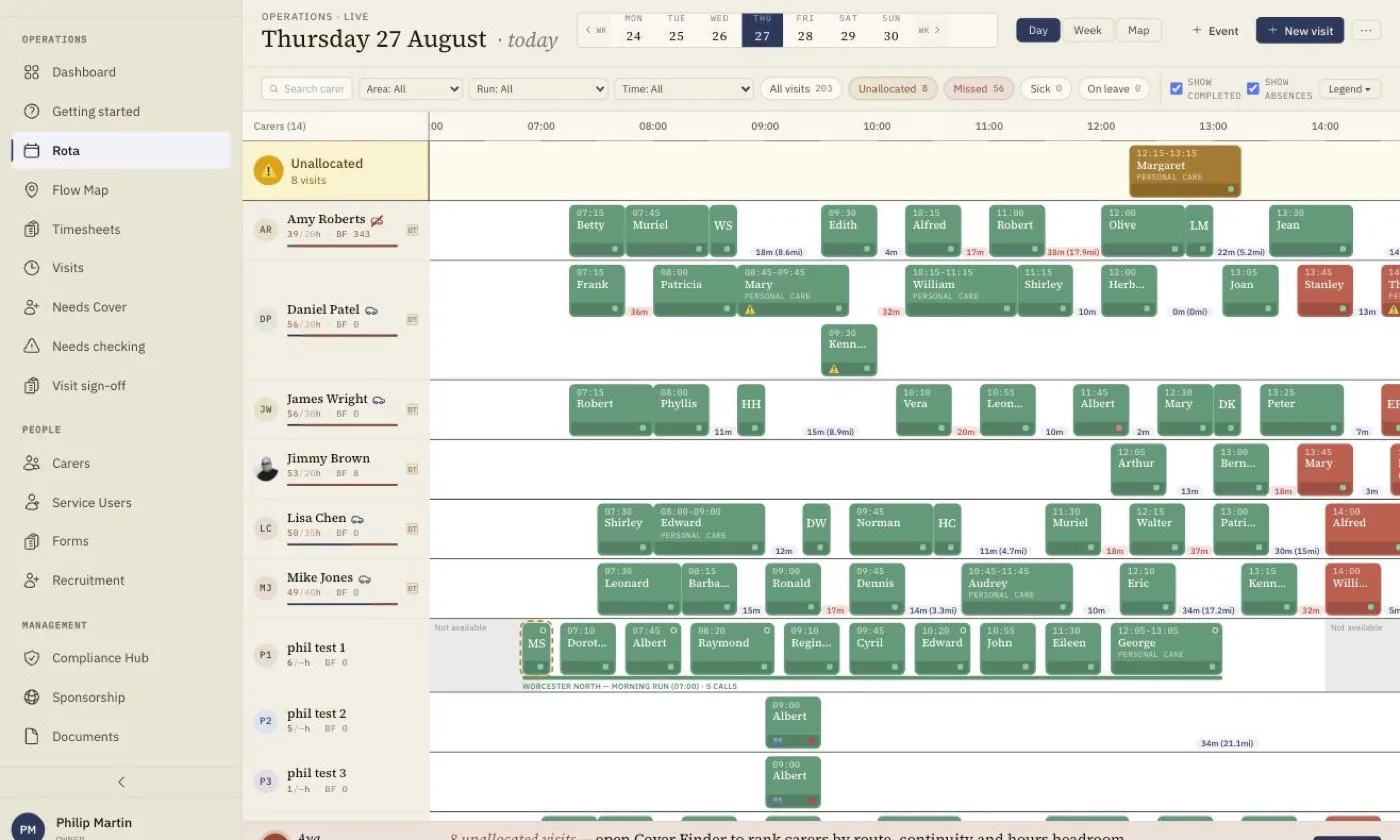
Most home care work is built around the times people need help, not around a factory clock. Demand tends to peak at getting-up time, lunch, tea and bedtime, with quieter periods in between. That shapes the patterns agencies use:
- Runs. A carer's shift is a sequence of visits with travel between them, rather than a fixed place of work.
- Split shifts. A morning run and an evening run on the same day, with a long unpaid gap in the middle.
- Long days. A carer works through from morning to evening, often with a lighter middle of the day.
- Part-time runs. Shorter runs that fit around school hours, studying or another job.
- Weekend rotations. Weekend calls shared out on a pattern, such as alternate weekends.
- Nights, waking nights and sleep-ins. Overnight support for people who need it, often in one home.
- Live-in care. Where you offer it, a carer stays with one person for a block of days.
- On-call. A senior or coordinator covering emergencies and short-notice gaps outside office hours.
There is no single right pattern. The HSE's guidance on fatigue makes the same point about shift work in general: work and workplaces vary so much that no one shift system suits everyone, but a planned, systematic approach to the risks helps.
The working time rules every rota has to meet
These are the main rules from GOV.UK that affect home care patterns. Your contracts can give carers more than this, but not less.
Rest breaks, daily rest and weekly rest
GOV.UK's guide to rest breaks at work says workers over 18 are usually entitled to:
- A rest break at work. One uninterrupted 20 minute break if they work more than 6 hours a day. Whether it is paid depends on the contract.
- Daily rest. 11 hours rest between working days. GOV.UK's example is that someone finishing at 8pm should not start again until 7am.
- Weekly rest. Either an uninterrupted 24 hours without any work each week, or 48 hours each fortnight.
The daily rest rule is the one late bed calls most often bump into. A carer who finishes at 10pm and is back on a 7am call has had 9 hours, not 11.
GOV.UK also explains compensatory rest. Some workers who cannot take the usual breaks are entitled to a rest of the same length instead. The listed situations include shift workers who cannot take daily or weekly rest between shifts, people who work in different places a reasonable distance apart, jobs that need round-the-clock staffing, and a working day that is split up. If your patterns depend on compensatory rest, write down why, make sure the rest actually happens, and take advice.
The 48 hour week
GOV.UK's guide to maximum weekly working hours says workers cannot work more than 48 hours a week on average, normally averaged over 17 weeks. Workers over 18 can opt out, but the opt-out must be voluntary and in writing, you must keep a record of it, and nobody can be sacked or treated unfairly for refusing. Carers can cancel an opt-out with at least 7 days' notice, or up to 3 months if their agreement says so.
An opt-out does not remove the rest break rules, and it does not remove your duty to manage fatigue.
Night work
GOV.UK's guide to night working hours says:
- Staff who regularly work at least 3 hours during the night period are night workers. The night period is 11pm to 6am unless you and the worker agree a different 7 hour period in writing that includes midnight to 5am.
- Night workers must not work more than an average of 8 hours in a 24 hour period, usually averaged over 17 weeks. They cannot opt out of this limit.
- Night workers whose work involves special hazards or mental or physical strain cannot work longer than 8 hours in any 24 hours. You need a risk assessment to identify that kind of work.
- You must keep records of night workers' hours for at least 2 years.
- You cannot discriminate against a worker who does not want to work nights.
Sleep-ins and pay
The same GOV.UK page explains that a care worker who is expected to sleep for most of a sleep-in shift, with suitable sleeping facilities, only gets the National Minimum Wage for the time they are awake to perform tasks. Someone expected to work for most of the shift gets the minimum wage for the whole shift.
Split shifts and runs raise their own pay questions, especially travel time between visits. Our guide to travel time and the minimum wage in home care covers which journeys count.
Flexible working requests
GOV.UK's guide to flexible working says employees can ask to change their hours, start and finish times, days or place of work from their first day in a job. You must deal with requests in a reasonable manner, and can refuse only for a good business reason. In home care, a request to drop bed calls or stop weekend work is a flexible working request, so handle it properly even if you cannot agree to it.
Fatigue: legal is not the same as safe
The HSE's fatigue guidance is clear that complying with the Working Time Regulations alone is not enough to manage the risks of fatigue. It says employers should:
- Manage fatigue like any other hazard, even when a worker is willing to do extra hours or prefers a pattern for social reasons.
- Risk assess changes to working hours.
- Consult staff on hours and shift patterns, while recognising that people sometimes prefer patterns that are not healthy.
- Have a policy that sets limits on working hours, overtime and shift swapping, and record hours, overtime, swaps and on-call work so the policy can be monitored.
- Treat regular problems with overtime and shift swapping as a sign that resources or staffing levels may not be right.
The key risk factors it lists are workload, the type of work, shift timing and length, the direction of rotation, and the number and length of breaks during and between shifts.
For home care, driving matters as much as hours. The HSE's hints and tips for shift workers point out that driving after a long shift, a night shift or before an early start can be risky. A carer finishing a late run and starting an early one is driving tired at both ends of the day. Our guide to lone working in home care covers the wider safety picture.
What CQC expects from your staffing
CQC's Regulation 18: Staffing requires providers to deploy enough suitably qualified, competent, skilled and experienced staff to meet people's needs at all times. Its safe and effective staffing quality statement expects appropriate staffing levels and skill mix so people get consistently safe, good quality care, and expects staff to get the support and supervision they need.
Shift patterns are where that becomes real. If your rota only works because a few carers keep picking up extra calls, or because visits are cut short to fit, your staffing is not as safe as it looks on paper.
How to design fairer shift patterns
These steps cost little and tend to make the biggest difference.
1. Start with what people need, then build runs around continuity
Map the call times people actually need, then group them into runs that the same carers can cover week after week. Consistent runs are easier for carers to plan around and better for the people they visit.
2. Plan realistic travel time
Runs that look fine on paper but leave no time to drive between calls push carers into rushing, late finishes and missed breaks. Build in real travel time, and review runs where carers are regularly late.
3. Protect daily rest between late and early calls
Check every carer's last call against their next first call. If a pattern regularly leaves less than 11 hours, change the pattern rather than relying on goodwill.
4. Share the hard shifts fairly and openly
Weekends, bank holidays, bed calls and short-notice cover are where resentment builds. Agree a clear way of sharing them, such as a weekend rotation, and make it visible so carers can see it is fair.
5. Ask carers what they can work, and write it down
Record each carer's availability and preferences when they join and review them in supervision. People's circumstances change, and a pattern that worked last year may not work now.
6. Publish the rota early and keep changes to a minimum
Last-minute changes make it hard for carers to arrange childcare or other commitments. Agree how far ahead you publish, stick to it, and explain changes when they happen.
7. Watch overtime, swaps and sickness
Track who is picking up extra hours and how often. Following the HSE's point above, a pattern of heavy overtime or constant swaps is usually a staffing problem, not a scheduling one.
8. Do not let the same willing carers carry the gaps
The carers who always say yes are often the ones who burn out and leave. If you are covering gaps with the same people, the real fix is recruiting. Our guide to how to recruit care workers in the UK has practical ideas.
Example patterns to compare
The table below is an example to help you think about trade-offs. It is not a recommended rota and the times are illustrative only.
| Example pattern | What carers often like | What to watch |
|---|---|---|
| Split shift: morning run, then tea and bed calls | Fits the busiest call times; free time in the middle of the day | Long working day overall; late finish then early start; travel time and pay in the gap |
| Long day with a quieter middle | Fewer days at work in the week | Fatigue towards the end of the day; a proper rest break |
| Part-time school-hours run | Fits around childcare and other commitments | Leaves bed calls and weekends for others to cover |
| Alternate weekends | Predictable time off that carers can plan around | Needs enough staff to cover both weekends fairly |
| Waking nights | Suits some carers' lives | Night worker limits, records and fatigue on the drive home |
| Sleep-ins | Overnight cover where a person needs someone nearby | Minimum wage rules for sleep time; suitable sleeping facilities |
A quick shift pattern checklist
| Check | What good looks like |
|---|---|
| Rest breaks | Carers working more than 6 hours get an uninterrupted 20 minute break that actually happens |
| Daily rest | At least 11 hours between working days, or compensatory rest where it genuinely applies |
| Weekly rest | 24 hours off each week or 48 hours each fortnight |
| 48 hour week | Hours averaged and tracked; any opt-outs voluntary, in writing and on file |
| Night workers | Identified, hours limited and records kept for at least 2 years |
| Fatigue | A policy on hours, overtime and swaps, with risk assessment of new patterns |
| Fairness | A clear, visible way of sharing weekends, bed calls and cover |
| Continuity | Regular runs so people see the same carers where possible |
| Flexibility | Flexible working requests handled reasonably, with a written response |
| Staffing | Overtime and gaps reviewed as a sign of whether you need to recruit |
How HomecareOS can help
Most shift pattern problems in home care come back to having too few carers for the calls you have. When you are short, the fair rota you planned turns into the same people covering bed calls and weekends again.
The HomecareOS recruitment portal helps you fill those gaps steadily. You invite an applicant by email, and they complete an online portal with their application, documents, right to work, two references, DBS details and a health questionnaire. You track every applicant through seven stages: application, documents, references, DBS, interview, offer and onboarding, so you can see who is waiting on what. When you hire, the applicant becomes a carer record that is ready to add to the rota.
Once new carers are in, our guides to onboarding new carers, care worker retention ideas and reducing carer turnover can help them settle and stay.
The HomecareOS recruitment portal is £49 a month. Start on the recruitment portal page, read the recruitment feature page, book a demo, or call Phil on 01905 674704.
Sources
- GOV.UK: rest breaks at work and compensatory rest, for rest breaks, daily and weekly rest.
- GOV.UK: maximum weekly working hours and opting out of the 48 hour week.
- GOV.UK: night working hours, for night worker limits, records and sleep-in pay.
- GOV.UK: flexible working, for the right to request flexible working.
- HSE: fatigue and hints and tips for shift workers, for managing fatigue and driving risk.
- CQC: Regulation 18, Staffing and safe and effective staffing quality statement.
- Acas, for advice on working hours and employment questions.