A pressure ulcer, also called a pressure sore or bed sore, is damage to the skin and the tissue underneath, caused by pressure or rubbing. The NHS page on pressure ulcers says they usually form over bony areas such as the heels, elbows, hips and tailbone, and that the chance of getting one is higher for people who have difficulty moving.
That describes a large share of the people a home care agency supports. The government's safeguarding protocol for pressure ulcers makes the point directly: many people who develop pressure ulcers receive care from family, friends or paid carers rather than healthcare services, so those carers need training in prevention, the early signs, and how and when to escalate.
This guide is for registered managers in England. It is not clinical advice. Treatment of a pressure ulcer belongs with a nurse or doctor. Prevention, noticing and reporting are where an agency makes the difference.
The guidance that applies
Three public sources cover most of what an agency needs.
- NICE guideline CG179, Pressure ulcers: prevention and management, sets out risk assessment, skin assessment, repositioning, equipment and treatment. It is written for healthcare professionals.
- NICE quality standard QS89, Pressure ulcers, says it applies to all settings, including people's own homes.
- NICE guideline NG21, Home care: delivering personal care and practical support to older people living in their own homes, says social care practitioners should liaise with healthcare practitioners so the home care plan promotes wellbeing, including overall skin integrity and preventive care (recommendation 1.3.15). It also says home care workers should be able to recognise and respond to common care needs, including issues related to overall skin integrity (recommendation 1.7.4).
The regulation behind all of this is Regulation 12, safe care and treatment. It requires a provider to assess risks to people's health and safety, do all that is reasonably practicable to reduce them, make sure staff are competent, and, where care is shared with others such as a district nursing team, work with them so that care planning is timely. CQC's guidance on Regulation 12 explains how it applies.
Who is at risk
NICE CG179 starts with a simple line: be aware that all patients are potentially at risk. It then lists risk factors, including:
- significantly limited mobility
- significant loss of sensation
- a previous or current pressure ulcer
- nutritional deficiency
- the inability to reposition themselves
- significant cognitive impairment
The NHS page adds being underweight, swollen, sweaty or broken skin, poor circulation or fragile skin, and recent serious illness or surgery.
CG179 says risk should be reassessed when something changes, for example after surgery, when a condition gets worse or when mobility changes. In home care, the first person to notice that change is often the carer. A hospital discharge, a fall, a new chest infection or a week of staying in bed should all prompt the question of whether the pressure risk is still the same.
NICE suggests validated scales such as Braden, Waterlow or Norton to support clinical judgement. In most home care packages that assessment is done by a district nurse or another healthcare professional. If your own staff use a scale, make sure they are trained in it and that the result goes into the risk assessment and the plan, not into a separate folder.
What goes in the care plan
CG179 asks for an individualised care plan for anyone at high risk, taking into account the risk and skin assessment, extra pressure relief needed at particular sites, the person's mobility and ability to reposition themselves, other conditions, and their own preferences.
For a home care plan, that usually means writing down:
- which areas of skin to check, and what the person or their nurse has said to look out for
- how often the person needs to change position, as agreed with their nurse, and who helps between calls
- the equipment in the home, such as a pressure-relieving mattress or cushion, who supplied it and who to call if it fails
- any heel offloading the nurse has recommended
- barrier creams or other skin products, and whether they are prescribed
- what the person prefers, including where they like to sit and sleep
- who to contact with a concern, with a phone number that works out of hours
NICE says to discuss a plan for offloading heel pressure with adults at high risk of heel ulcers, and to think about the seating needs of people who sit for long periods. Both are easy to miss in a plan written around tasks. Person-centred care plan examples shows how to write a section in the person's own terms.
Repositioning and the gaps between calls
NICE CG179 says to encourage adults at risk to change position frequently and at least every 6 hours, and adults at high risk at least every 4 hours. If they cannot reposition themselves, help should be offered, using equipment where needed, and the frequency each person needs should be documented.
Home care has a particular problem here. A person with four calls a day may have long gaps, especially overnight. The plan needs to say honestly how repositioning happens in those gaps: the person moves themselves, a family member helps, night support is in place, or the gap is a risk that needs raising with the person, their family and the commissioner.
When the agency is responsible for repositioning on a call, the record should show the time, the position and anything noticed. A note that just says "repositioned" on every call for a month gives an inspector, a nurse or a safeguarding enquiry very little to go on.
Checking skin on every call
The NHS page lists the symptoms to look for:
- discoloured patches of skin that do not change colour when pressed, usually red on white skin, or purple or blue on black or brown skin
- skin that feels warm, spongy or hard
- pain or itchiness in the area
NICE also asks healthcare professionals to be aware that early damage can show as colour change or discolouration, particularly in darker skin tones. The safeguarding protocol says damage can be present before it is visible, and that the earliest signs are most commonly pain or numbness, then changes in texture or firmness, temperature and finally colour.
That shapes training. Carers need to know to ask about pain over bony areas, not only to look for redness. NICE also says not to massage or rub skin to prevent a pressure ulcer, which is worth saying plainly in induction because it is a habit some people bring with them.
Recording and reporting
The protocol says all levels of skin damage caused by pressure or shear should be reported through local reporting systems. Find out what yours is. It is usually agreed between the NHS community team, the council and the local Safeguarding Adults Board, and it may include a specific form.
The protocol also distinguishes types of damage. Damage established to be caused by incontinence or moisture alone should be recorded as moisture-associated skin damage, not as a pressure ulcer. Damage caused by both moisture and pressure should be recorded as a pressure ulcer, as should damage caused by a device. A carer is not expected to make that clinical judgement on the doorstep. They are expected to describe what they see, mark where it is, and report it the same day.
A good record of a skin concern says:
- where it is, ideally marked on a body map
- what it looks like and whether the person reports pain
- when it was first noticed and by whom
- who was told, and what they said
- what was done on the call, such as repositioning or a change of seating
CG179 asks clinicians to document the size of a pressure ulcer, for example by tracing or a photograph. If your agency takes photographs, have a policy on consent, who can view them and where they are stored. CQC's guidance on Regulation 17 covers the wider record. How to write care notes covers what a useful note looks like.
When to raise a safeguarding concern
The protocol's guidance page, published by the Department of Health and Social Care and last updated in June 2025, describes pressure ulcers as primarily a matter for clinical investigation rather than a local authority safeguarding enquiry. It replaced the 2018 protocol, which was withdrawn in 2023.
It does not say a pressure ulcer is never a safeguarding matter. Pressure ulcers can result from neglect, including acts of omission such as ignoring care needs or failing to provide access to healthcare. Where the clinician assessing the ulcer is concerned that abuse or neglect is directly associated with it, a safeguarding concern should be raised within the organisation, and in a minority of cases with the local authority. The guidance page links to an adult safeguarding decision guide, a body map and a concern proforma.
For an agency, two things follow. First, your own staff need to know that reporting pressure damage is expected, and that it is not an accusation against a colleague. Second, if the cause may be something your agency did or did not do, such as missed or short calls, or a repositioning plan that was not followed, that belongs in your safeguarding procedure and may engage the duty of candour. Check whether the incident also needs a CQC notification.
Training
The protocol says unpaid and paid carers need training in prevention, the signs of developing pressure ulcers, and how and when to escalate. NICE CG179 lists what training on prevention should cover: who is most at risk, how to identify pressure damage, what steps prevent new or further damage, and who to contact. Staff who support people at high risk need more, including how to reposition and how pressure-relieving equipment works.
Fit this into your mandatory training and check it in practice through observation and supervision, not only by a certificate.
A short checklist for registered managers
- Does every care plan for someone at risk say how often they need to change position, and who helps between calls?
- Is the equipment in each home recorded, with a contact for faults?
- Do carers know to ask about pain, and to check skin rather than rely on redness alone?
- Is there a clear, same-day route for a carer to report a skin concern, including out of hours?
- Do you know your local reporting system and the safeguarding decision guide?
- When risk changes after a discharge or a fall, does someone review the plan with the nurse?
Where software fits
Software does not prevent a pressure ulcer. People do, by checking skin, moving the person and passing on what they see. What software can do is make the record complete and visible.
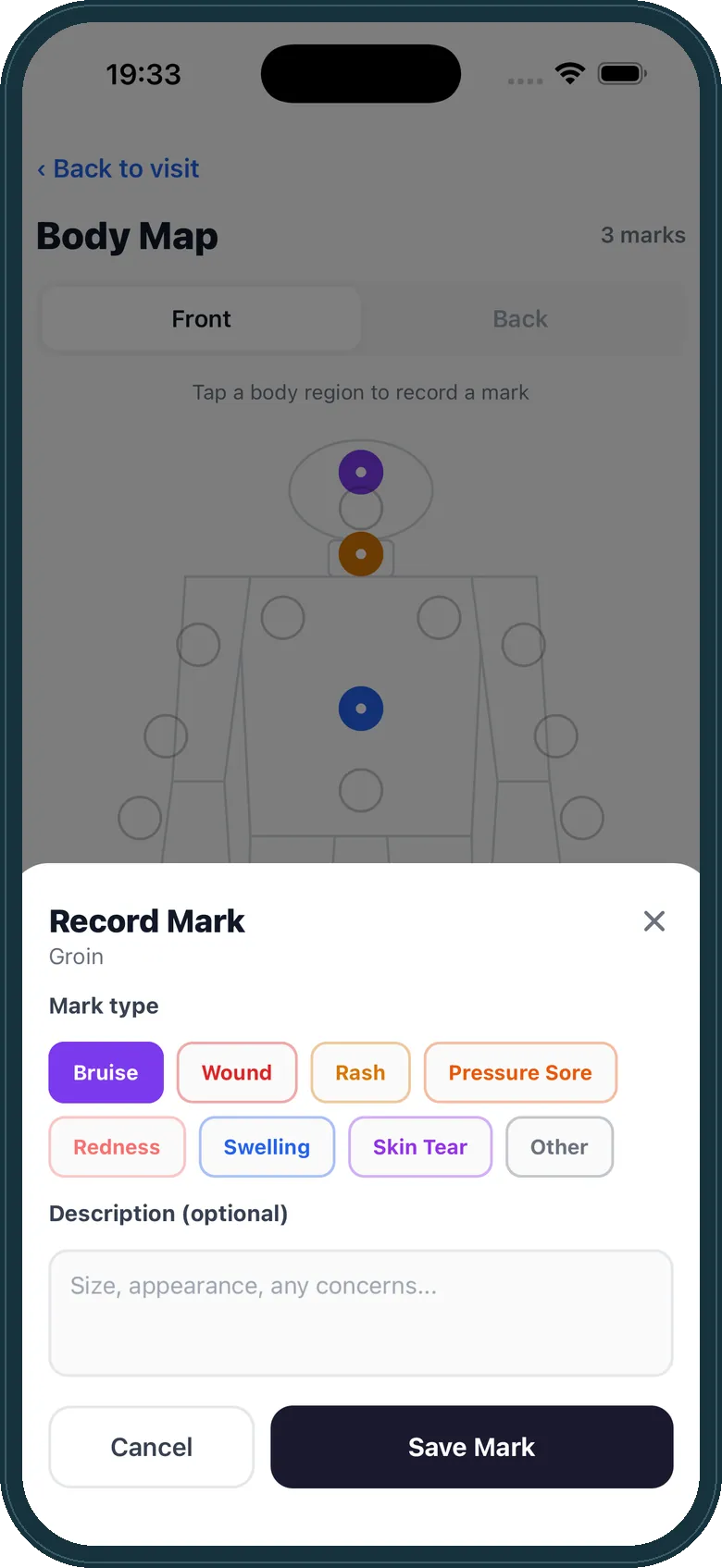
In HomecareOS, carers can mark skin integrity, bruising or pressure areas on a front or back body map during a visit, record repositioning as one of the observation types, and add photographs to the same visit. Those entries are dated, attributed and kept on the person's digital care record, so the office and the next carer can see them. The policy library includes a repositioning and turning chart template. These are features of our product, not regulatory requirements, and they do not replace your local reporting system.
To see how that looks on a real record, book a short demo or call 01905 674704.
Sources
- Pressure ulcers: prevention and management (CG179), NICE, for risk factors, repositioning frequency, skin assessment, care planning and training.
- Pressure ulcers quality standard (QS89), NICE, for its scope, which includes people's own homes.
- Home care: delivering personal care and practical support (NG21), NICE, recommendations 1.3.15 and 1.7.4.
- Pressure ulcers (pressure sores), NHS, for symptoms, causes and prevention at home.
- Pressure ulcers: how to safeguard adults and the safeguarding adults protocol, Department of Health and Social Care.
- Regulation 12 and CQC's guidance on Regulation 12.
- HomecareOS digital care records, for body maps, repositioning observations and photographs. That page describes our product.