Safer recruitment in domiciliary care is how a registered manager decides who is fit to walk into someone else's home alone. It is not a folder label. For agencies in England it sits under Regulation 19 of the Health and Social Care Act 2008 (Regulated Activities) Regulations 2014, Schedule 3, and CQC's guidance on Regulation 19.
This post is about the recruitment process CQC expects. It is not a duplicate of our staff file requirements guide, which lists what must sit on the file once the checks are done. For the practical pack (right to work, DBS, references, health questionnaire), use the care worker recruitment checklist. For attracting applicants and running a pipeline, see how to recruit care workers and applicant tracking for home care agencies.
What Regulation 19 actually requires
Regulation 19 is the fit and proper persons employed duty. People employed for a regulated activity must:
- be of good character
- have the qualifications, competence, skills and experience necessary for the work
- be able, by reason of their health after reasonable adjustments, to perform the tasks that are intrinsic to the role
Providers must establish and operate recruitment procedures that make those conditions true. Schedule 3 information must be available for each person employed, and CQC's guidance says that information must be confirmed before they are employed. Where someone later stops meeting the criteria, regulation 19(5) requires necessary and proportionate action, and referral to a professional regulator where that applies.
"Person employed" is wider than payroll. CQC's guidance says it includes volunteers, contractors, and agency or bank staff. The full employment history in Schedule 3 does not apply to most volunteers, except where the volunteer is a provider, director or registered manager.
CQC cannot prosecute for a breach of Regulation 19 itself, but it can take regulatory action, and it must refuse registration if a provider cannot satisfy CQC that they can and will comply.
What CQC wants to see in your recruitment policy
When you register, CQC asks for a recruitment policy and procedures supporting document. That page is a clear map of the process inspectors expect you to operate, not only to write down.
Your policy should show:
- how recruitment is fair and complies with the law
- the stages of the process — for example advert, application, shortlisting, interview, checking identity, taking up references, DBS check, offering the post
- what you check at each stage
- your approach to volunteers and apprentices where they apply
- a recruitment complaints procedure
- what references you require
- how you check previous employment history, especially health or social care work or work with children or vulnerable adults
- how you verify why previous employment ended
- any separate approach to sponsoring overseas workers
It should also show how you comply with the Equality Act 2010, UK GDPR and the Data Protection Act 2018. Pre-employment health questions belong in that Equality Act frame: gather what you need for the intrinsic tasks of the role, after reasonable adjustments, without turning the interview into an irrelevant medical interrogation.
Good character, competence and ongoing fitness
Good character is not a vibes test. CQC expects robust processes that gather available information and have regard to honesty, trust, reliability and respect. If information later suggests someone is not of good character, you must act. If you appoint despite Schedule 3 concerns, record your reasons.
Competence sits beside character. Providers must assess competence before someone works unsupervised, and provide appropriate supervision until that assessment is done. CQC expects providers that employ healthcare assistants and social care support workers to follow the Care Certificate standards when assessing competence. A person may join with the expectation that they will become competent within a set timeframe while training, but that does not mean they should be left alone on a first visit before your own competence gate is met. Our Care Certificate guide covers induction evidence in more detail.
Fitness is not a one-off. Regulation 19(5) and CQC's guidance require regular review of employees' fitness and a fair, timely response when concerns arise, including interim measures if people using the service could be at risk.
Why domiciliary care makes the process sharper
In a care home, colleagues are usually on the same floor. In domiciliary care, a new worker often goes alone into a private home. That is why values and suitability at interview matter as much as the paperwork, and why your policy should be clear that Schedule 3 checks and competence assessment come before unsupervised visits.
Interview questions should test honesty about history, understanding of dignity and safeguarding, and how the person would handle a closed front door, a medication prompt, or a family dispute — without inventing a “pass mark” that is not in your policy. Shortlisting and interview design should still meet the Equality Act.
DBS is one stage, not the whole process. For eligibility and certificate handling, use the DBS check for care workers guide. Safer recruitment still needs identity, employment history, explanations for gaps, references, verification of why relevant previous employment ended, health information relevant to the role, and any qualification evidence Schedule 3 expects.
If another party (an agency or umbrella body) runs checks, CQC still expects you to assure yourself that those checks are complete and satisfactory before the person works for you.
Keep the process and the file as two linked jobs
| Job | What it is for | Where to read more |
|---|---|---|
| Safer recruitment process | Stages from advert to offer, fairness, competence before unsupervised work | This post; CQC recruitment policy supporting document |
| Staff file | Proof that Schedule 3 and related records exist for each person | Staff file requirements |
| Practical checklist | Right to work, DBS, references, health questionnaire | Recruitment checklist |
| Pipeline | One record per applicant, dated stages | Applicant tracking |
| Attracting applicants | Ads, values-based screening, onboarding habits | How to recruit care workers |
Do not treat a coloured spreadsheet cell as a completed stage. Inspectors sample files and ask how you decided someone was fit for a solo visit.
How HomecareOS helps
HomecareOS is built around the recruitment process registered managers already run:
- You invite an applicant by email only (SMS invites are not built).
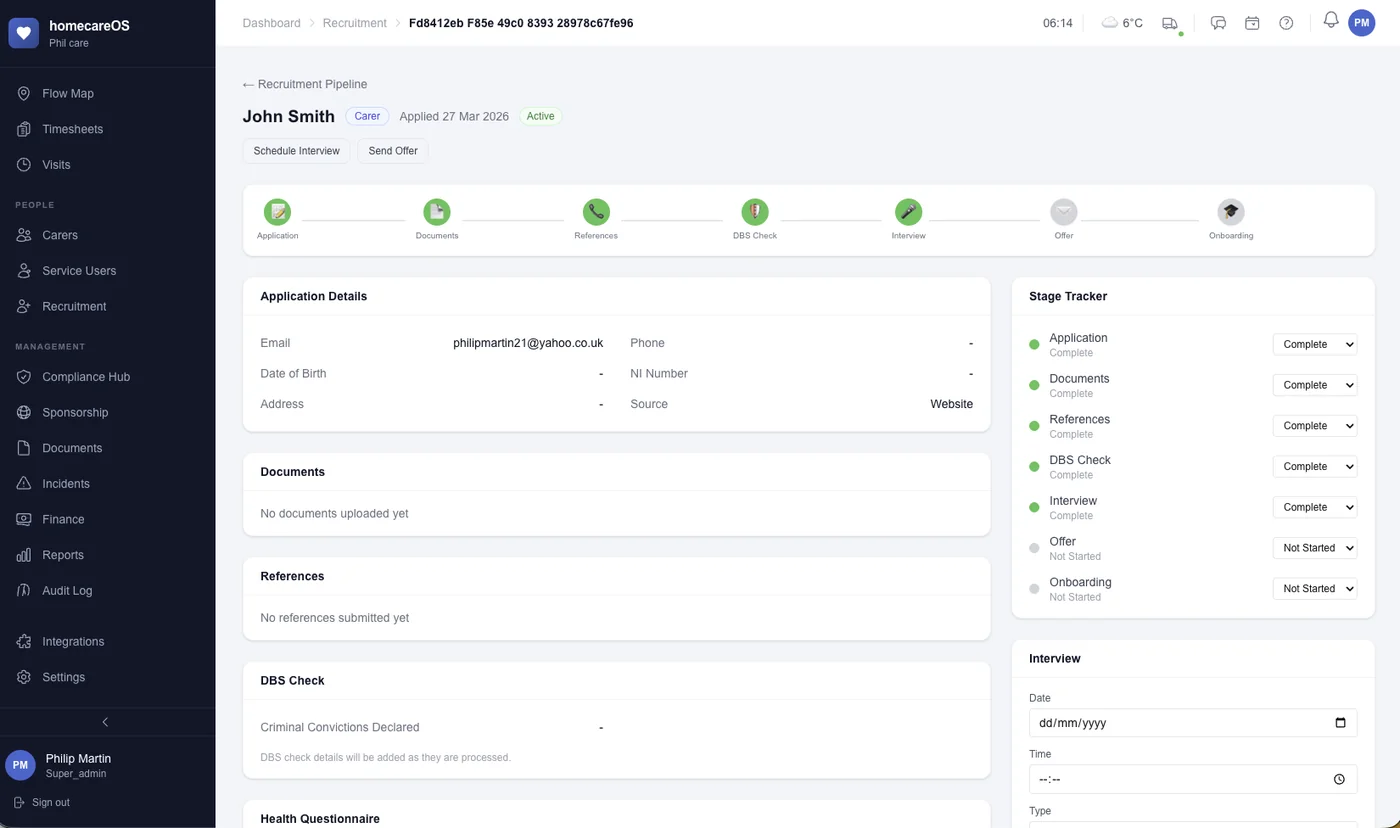
- The applicant completes an online /apply journey covering the application, documents, right to work, two references, DBS details and a health questionnaire.
- You track seven stages: application, documents, references, DBS, interview, offer, onboarding.
- On hire, the applicant converts to a carer record ready to be added to the rota — not added automatically.
- Agencies that sign up now get recruitment £49 a month plus VAT.
Open the recruitment portal offer, see recruitment features, book a demo, or call Phil on 01905 674704.
Sources
- Regulation 19: Fit and proper persons employed and Schedule 3 on legislation.gov.uk.
- CQC guidance on Regulation 19 (good character, competence before unsupervised work, Care Certificate expectation, person employed, ongoing fitness).
- CQC recruitment policy and procedures supporting document (stages, fair recruitment, Equality Act, UK GDPR, checking why previous employment ended).
- HomecareOS recruitment features and the recruitment portal.