Key takeaways
- Which is best? It depends on your situation. On published facts, TagCare and CareLineLive have the lowest per-carer prices, Birdie, Access and CareLineLive are on NHS England's assured list, and Log my Care is free under 10 service users. The comparison table covers all 16, us included.
- What does it cost? Only 6 of the 15 other platforms in our comparison table publish a paid price on their own website. Of those, TagCare lists £5 per carer per month and Birdie starts from £200 a month (sources in the table), so compare the pricing unit as well as the rate.
- What must it do? A drag-and-drop rota, a carer app that works offline, care records and eMAR, training and background-check tracking, and invoicing and payroll export.
- Which regulator? CQC, CIW, the Care Inspectorate and RQIA inspect differently. Outside England, check regulator fit first.
Who wrote this: homecareOS publishes this guide, so we are one of the vendors in it, and we say where we fit less well. How we checked the other platforms is set out with the comparison table. Spotted something out of date? Tell us at hello@homecareos.co.uk.
What home care software actually is
What does home care software do? Home care software runs the day-to-day operations of a domiciliary care agency in one system. It schedules visits, records care plans, daily notes and electronic medication administration records (eMAR), verifies attendance through GPS check-in on a carer's phone, tracks training and background-check expiries, and turns delivered visits into invoices and payroll figures. It replaces separate tools such as paper rotas, spreadsheets, a standalone eMAR app and a billing package.
"Home care software", also called domiciliary care software, home care management software, a domiciliary care management system or just care rostering software, combines workforce scheduling, regulated care records and field-service management in one platform. Its core jobs are:
- Scheduling visits: matching carers to service users across the week, with travel time between calls, double-ups, shadow shifts, run templates and last-minute cover
- Care records: digital care plans, daily care notes, body maps, observations, goals and electronic medication administration records (eMAR)
- Carer mobile app: GPS-verified check-in, offline-capable note taking, MAR signing and document access
- Compliance: training and background-check (DBS, PVG or AccessNI) expiry tracking, supervisions, audits, incident logs and evidence for your regulator
- Finance: payer, service and rate management, invoicing (private and council), payroll exports and mileage claims
- Family access: a portal or app where relatives can see upcoming and completed visits and, where the agency allows it, care notes. Some platforms also let families message the office or query a visit.
One thing home care software isn't: residential care home software. The two are registered as different types of service. In England a home care agency registers with CQC for the regulated activity "personal care", and a care home for "accommodation for persons who require nursing or personal care". Some vendors sell to both markets (Nourish, Log my Care, OneAdvanced), while Birdie, CareLineLive and homecareOS are built specifically for home care. If a vendor pitches one product for both, ask which one its developers invest in most.
UK home care software providers compared
Which is the best home care software in the UK?
No platform is best for every agency. Based on what vendors publish (checked 18 September 2026), this is where each tends to fit:
- NHS or council contracts in England: ask your commissioner whether it expects a system on NHS England's assured list, and if it does, start with listed systems such as Birdie, Access Care Planning, CareLineLive, Log my Care, Nourish and PASS by everyLIFE.
- Lowest published per-carer price: TagCare (£5 per carer per month) and CareLineLive (from £8.10, with a £120 monthly minimum).
- Very small or new agencies: Log my Care (free Starter plan under 10 service users) and homecareOS (free for the first 5 carers). Check what each free plan leaves out.
- Wales: CareCallAI, built in Wales with Welsh-language support. Ask any other vendor to show CIW and Social Care Wales fields working.
- Scotland or Northern Ireland: ask every vendor for a worked example with your own regulator, workforce register and background check.
- Home care alongside care homes or supported living: Nourish, Log my Care, Care Control or OneAdvanced, which sell to both.
- Multi-branch groups with complex council billing: include the long-established enterprise suppliers, such as Access and OneAdvanced, on the shortlist (see our notes on multi-branch groups).
How we compared the platforms
We keep comparison pages for 16 UK platforms. For the table we checked each vendor's own website and published prices, the government's G-Cloud 14 and G-Cloud 15 price lists on the Digital Marketplace, and NHS England's assured solutions list, all on 18 September 2026. G-Cloud prices are the maximum a public sector buyer pays, so a private agency's quote may differ. We have not tested these products hands-on, and we left out anything we could not find in a public source. Prices exclude VAT, except CareCallAI, whose pricing page does not say either way. Click a name for the full comparison.
| Platform | Built for | How it prices | Published price | NHS assured list (England) |
|---|---|---|---|---|
| Birdie | Home care | By care hours scheduled | From £200 a month | Yes |
| Access Care Planning | Home care and care homes (Access prices it per carer or per bed) | Quoted case by case, as an annual cost per carer | G-Cloud 14: £10.49 to £11.86 per active employee per month | Yes |
| Log my Care | Residential, supported living and home care | Free Starter plan under 10 service users; Pro quoted | Starter free; Pro not published | Yes |
| CareLineLive | Home care | Per carer; office users free | From £8.10 per carer per month, £120 monthly minimum | Yes |
| Person Centred Software | Care homes first; lists domiciliary care among settings served | Not published | Not published | Yes |
| Nourish (including CarePlanner) | Care homes and home care | By hours of care rostered (home care) or per bed (care homes) | G-Cloud 15: Better Care at Home £0.20 per hour of care rostered, £160 monthly minimum | Yes |
| OneTouch Health (including OnePlan) | Home care and residential | Per monthly active staff user | G-Cloud 15: up to £15 per user per month for the full platform, plus a £1,500 implementation fee | Yes (as OneTouch) |
| OneAdvanced (IQ Care) | Residential, domiciliary and supported living | Annual licence by number of users | G-Cloud 15: Care Business Management from £11,900 a year for up to 69 users | No |
| Unique IQ | Home care, supported living and complex care | Per active carer | Figures not published | No |
| CareCallAI | Home care in England and Wales | Plans by staff count, with a charge per extra user | From £99 a month for up to 15 staff, then £5 per extra user | No |
| Care Control | Care homes, domiciliary care and supported living | Not published | Not published | Yes |
| everyLIFE PASS | Home care, supported living, complex care and reablement | Per service, then per service user | From £185 a month for up to 15 service users | Yes |
| QuikPlan | Home care rostering and finance | By quote | Not published | No |
| ShiftCare | Home care and disability support (founded in Australia) | Per user, office staff included, minimum 5 | From £7 per user per month billed yearly | No |
| TagCare | Home care | Per carer | £5 per carer per month, no setup fee | Yes |
| homecareOS (publisher of this guide) | Home care | Per carer; office users and service users never counted | Free for the first 5 carers (core platform included), then £10 per carer per month for every carer | No |
Ownership changes worth knowing about
Several names have moved. Access Care Planning was formerly Mobizio, and its rostering is sold as a separate Access product (Access pricing). Nourish bought CarePlanner in 2023, and CarePlanner's rostering is now Nourish Empower. OneTouch Health bought OnePlan in 2024 and sells it as OneTouch Essentials; it is a separate company from OneAdvanced, whose suite is now IQ Care. Person Centred Software bought the eMAR provider Camascope in June 2026.
Other systems you may meet include QCS Care Management Software (formerly Carebeans), which is on NHS England's assured list, Nursebuddy and OnCare. We do not keep comparison pages for these yet.
The full hub is at homecareOS vs every UK home care platform. For a structured "do I need an alternative to platform X" frame, see our Birdie alternatives UK roundup.
Where homecareOS lands
For the sake of honesty: homecareOS is the platform behind this guide. We are a new challenger, founded in 2026, and our first agencies joined in April 2026, so we cannot point to a long track record. We focus on four-nation coverage (each agency is set up against its own regulator, workforce register and background check), per-carer pricing that never counts office staff who do not deliver visits, and scheduling, care records, eMAR, invoicing and payroll in one platform.
We fit best for agencies frustrated by per-user pricing, small agencies, and agencies in Wales or Scotland that are tired of England-first software. We support RQIA, NISCC and AccessNI, but no Northern Ireland agency uses homecareOS yet, so ask us for the same worked example you would ask anyone else. It is free until you go past five carers, and the free plan keeps the core platform: scheduling, care records, eMAR, the carer app, invoicing, payroll and the family portal. Once you pass five, the free allowance is used up, so an agency that later drops back to five carers pays £50 a month.
We fit less well for large groups whose council contracts need invoices submitted in a specific electronic format or through a council portal we do not yet export to (ask us for a sample export before you commit), and for agencies that need everything an older platform has built up over many years.
See the full homecareOS feature list for what's included and homecareOS pricing for the per-carer detail. If you want to test it against your own rota, start free with up to five carers.
Is domiciliary care software the same as home care software?
Yes. Home care software, domiciliary care software, homecare software and a domiciliary care management system all describe the platform an agency uses to plan, deliver and evidence care in people's own homes. "Domiciliary care" is the formal term used in tenders and in registration in England, Wales and Northern Ireland. Scotland is the exception: the Care Inspectorate registers the same work as a support service providing care at home. The distinction that does matter is home care versus care home, which we cover in home care vs care home software.
The UK home care software market in 2026
The market splits roughly into three archetypes. Knowing which one a platform belongs to tells you more than any single review.
1. Long-established enterprise suppliers
Large suites from established software groups, aimed at bigger and multi-service providers. They sell separate modules for care planning, rostering, billing and payroll, and they quote prices rather than publish them. Access, for example, lists an annual fee invoiced in advance plus a one-off implementation fee in its G-Cloud 14 pricing (see the pricing table below). Examples: OneAdvanced (IQ Care), which says it has more than 30 years in the care sector, and Access (Access Care Planning, with rostering sold separately as Access People Planner). Person Centred Software is also well established, but its site leads on care homes.
2. Modern cloud platforms
Cloud platforms with carer mobile apps, most of which do not publish a full price list. Pricing models differ: Birdie prices by the care hours you schedule, while CareLineLive and Unique IQ price per carer. Examples: Birdie, CareLineLive, Nourish (which acquired CarePlanner in October 2023) and Unique IQ.
3. Newer challengers
Recent entrants that publish their prices and compete on a specific strength rather than feature breadth. CareCallAI, built in Wales, focuses on Welsh-language support and CIW. homecareOS, founded in 2026, focuses on covering all four UK regulators and on per-carer pricing that never counts office staff who do not deliver visits.
The four-nation framework: how UK regulators shape what you need
Of seven UK "best home care software" round-ups we checked on 18 September 2026 (from Birdie, the Access Group, Unique IQ, everyLIFE, ESRE Media, Hey Jodie and CareCallAI), six name CQC and no other regulator, and none mentions the Care Inspectorate or RQIA. If you operate in Wales, Scotland or Northern Ireland, check regulator fit before you compare anything else.
| Nation | Regulator | Inspection framework | Background check | Workforce register | What to check in the software |
|---|---|---|---|---|---|
| England | CQC | Five key questions (safe, effective, caring, responsive, well-led), with evidence mapped to the single assessment framework; annual Provider Information Return | Enhanced DBS with adults' barred list | No compulsory register | Evidence mapped to the five key questions, and PIR figures |
| Wales | Care Inspectorate Wales (CIW) | Ratings since April 2025 on three themes: well-being, care and support, leadership and management; annual return | DBS | Social Care Wales, within six months of starting | CIW themes rather than CQC's, an SCW number separate from DBS, and the Welsh-language Active Offer |
| Scotland | The Care Inspectorate (care at home is a support service) | Its own quality frameworks, graded on a six-point scale | PVG scheme, renewed every five years | SSSC, within six months of starting | PVG and SSSC fields, and reporting against the Care Inspectorate's framework |
| Northern Ireland | RQIA | Domiciliary Care Agencies Regulations 2007 and Minimum Standards (updated May 2026): safe, effective, compassionate, well led | AccessNI | NISCC, within six months of starting | AccessNI and NISCC fields, and RQIA evidence templates |
In England the framework is changing. CQC has consulted on draft sector-specific assessment frameworks, including one for adult social care, that keep the five key questions and reframe the quality statements as questions similar to the old key lines of enquiry. CQC is piloting the new approach between June and October 2026 and has not yet confirmed when it will replace the current framework (check CQC's improvement updates for the date). Ask any vendor how their templates will follow the change.
For the detail in each nation, see our compliance guides for CQC, CIW, the Care Inspectorate and RQIA, and our registration guides for England, Wales, Scotland and Northern Ireland.
Practical test: search the platform's website for your own regulator and workforce register ("CIW" and "Social Care Wales", "Care Inspectorate" and "SSSC", or "RQIA" and "NISCC"). If nothing comes up, ask to see those fields working in a demo before assuming they exist.
homecareOS supports all four UK regulators, setting the regulator, workforce register and background check from the agency's nation, though we have no Northern Ireland customers yet. CareCallAI, built in Wales, covers CIW and CQC. In September 2026 Birdie's site said its assessments also support Care Inspectorate Scotland and CIW inspections, and CareLineLive's homepage named CQC and CIW and a Northern Ireland health trust customer. None of the three mentioned RQIA on the pages we checked, so a Northern Ireland agency should ask any vendor for a worked example. Our four-nation compliance comparison sets the regulators side by side.
NHS digital social care records and the assured solutions list (England)
In England, NHS England keeps an assured solutions list of digital social care record (DSCR) systems. Listed systems have been assessed as offering the core capabilities a care provider needs. It is separate from regulation: CQC does not endorse any particular record system, and the agency has to assure itself that whatever system it uses meets its needs.
If you hold NHS or council contracts, ask your commissioner whether they expect an assured system before you shortlist. When we checked on 18 September 2026, the list included most of the platforms in our comparison table (see its last column), plus QCS Care Management Software (formerly Carebeans). OneAdvanced, Unique IQ, CareCallAI, QuikPlan, ShiftCare and homecareOS were not on it. The list changes, so check it on the day you decide.
The Data Security and Protection Toolkit (DSPT) is a separate self-assessment the agency completes for itself; assured software does not complete it for you.
What home care management software should do in 2026
Whether a vendor calls it home care management software or a domiciliary care management system, the feature lists use the same headings (scheduling, eMAR, care plans, invoicing), so they are hard to tell apart from the website alone. Here's what to look for in 2026, grouped by category, with what "good" looks like.
Scheduling
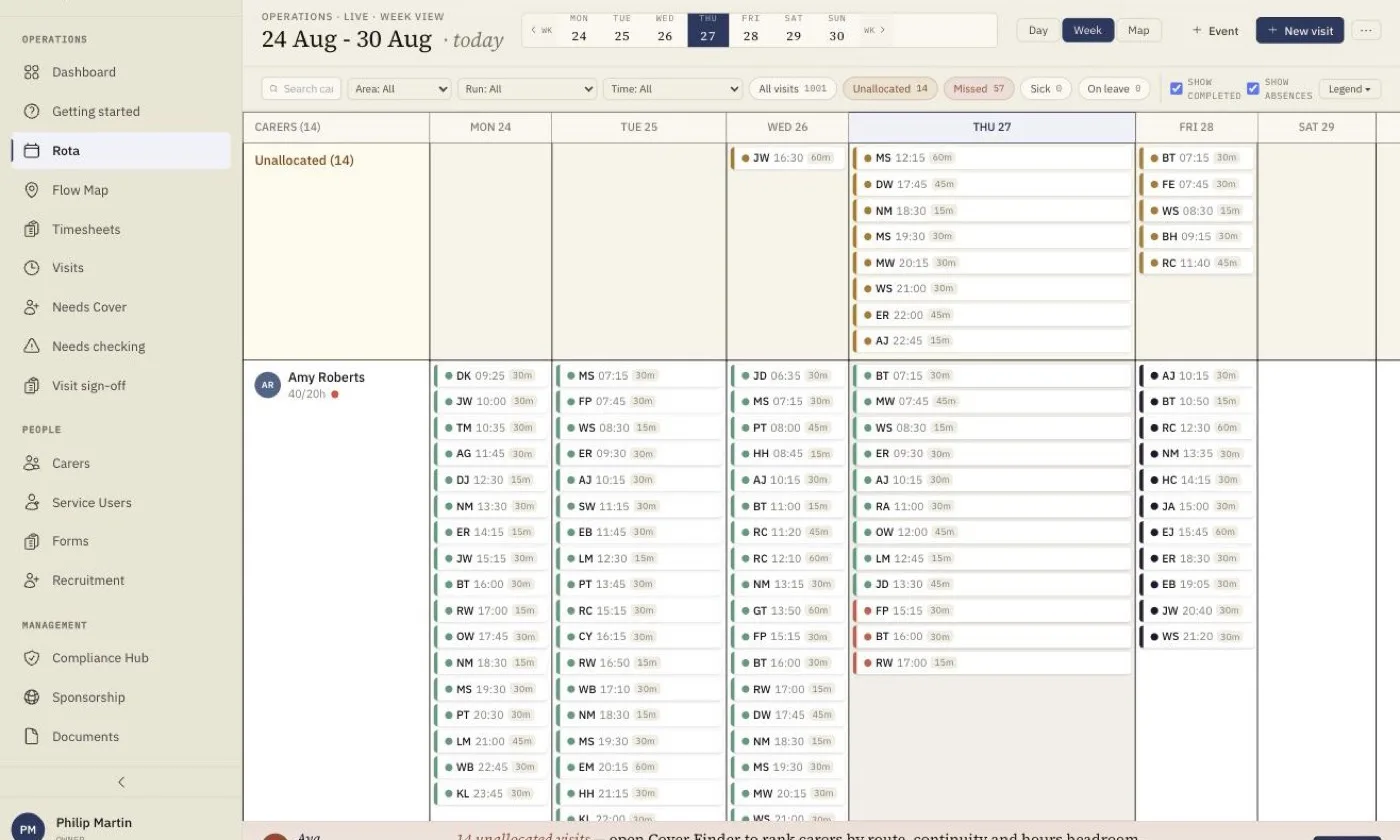
- A true drag-and-drop rota grid, not a list view that calls itself a rota. In the trial, load a full week at your real carer count and check that dragging still responds instantly.
- Run templates: recurring patterns you can apply once and edit individually
- Double-ups and shadow shifts as proper roles on the visit (lead carer, second carer, shadow), so pay and billing follow each person
- Cover finder for last-minute absences: shows who is actually free (not on leave, not already booked) and ranks them on continuity with the client, hours left in their week and travel time
- Travel time between calls on the rota, and runs you can check on a map (see route planning for domiciliary care)
- Independent planned, actual, paid and charged times, so what you bill and what you pay the carer can differ
Our guide to building a home care rota goes further.
Carer mobile app
- Truly offline: care notes captured on a no-signal visit must sync later without data loss
- Electronic call monitoring (ECM): check-in and check-out verified by GPS, NFC tag or QR code, with a manual override for when a carer has to phone in
- eMAR with controlled-drug double-sign
- eMAR that uses NHS dm+d medicine names, so prescriptions match what the pharmacy supplies
- Body map for wound and skin observations
- Pay transparency: carers can see their projected earnings and mileage
- Mobile holiday requests: carers ask for leave in the app and see the answer there. Ask whether every customer has it or only those on a newer version.
Care records and compliance
- Nation-appropriate evidence templates (see above)
- Training and DBS/PVG/AccessNI expiry tracking with carer-facing alerts
- Bradford Factor calculation for absence patterns, with RAG thresholds that match your absence policy and a way to keep pregnancy-related sickness out of the score, which Acas says should not count towards trigger points (the position in Great Britain; Northern Ireland has its own equality law). See our Bradford Factor guide
- Incident management that flags which incidents need a statutory notification to your regulator and records when it was sent
- Audit trail: who recorded or corrected a care note or MAR entry, and when. Ask to see the history of a corrected medication record.
- Reporting: which reports are in the base price, and whether they export
Billing, invoicing and payroll
- Payer, service and rate-band model: handles 15, 30, 45 and 60-minute bands, fixed-fee live-in and sleeping nights, and council and private rates side by side
- Invoice generation with the line-level detail councils ask for (local authority billing)
- Payroll export your payroll package imports without retyping. Ask which packages by name and whether the link is direct or a file you upload.
- Mileage claims at a rate you set, checked against HMRC's approved mileage allowance payments: for cars and vans in 2026 to 2027, 55p a mile for the first 10,000 business miles and 25p after that
More on carer payroll software.
Family portal and commissioner reporting
- Family portal: ask exactly what relatives can see (visit confirmations, the carer's name and photo, care summaries, medication records) and whether they are alerted to a missed visit.
- Commissioner reporting: can you give a council or ICB contract monitor planned versus actual visit evidence as an export, without building a spreadsheet by hand? And, if your council runs its own call monitoring system, can the platform send visit times to it?
Ask to see each feature working in the demo. "Coming soon" on a non-negotiable is a red flag.
How homecareOS handles each of these: scheduling, carer app, care records and eMAR, compliance, finance and payroll exports (Sage, Xero, BrightPay, CSV), recruitment and staff files and family portal.
Home care software pricing: the models compared
UK home care software is priced in several different units, and the unit matters as much as the headline rate. Only 6 of the 15 other platforms in our comparison table publish a paid price on their own website. Access, Nourish, OneTouch and OneAdvanced publish rates only in their G-Cloud price lists, and Log my Care publishes only its free Starter plan. The Access Group's own pricing guide says per-carer licensing is the most common model, and puts rostering at £5 to £12 per care worker per month and combined rostering and care planning at £12 to £35.
| Pricing model | What you pay for | Published examples | Watch for |
|---|---|---|---|
| Per carer | Care workers; office logins are often cheaper or free (CareLineLive charges nothing for them) | TagCare, CareLineLive, Unique IQ, homecareOS | Which carers count (everyone on the books, or only active ones), when the count is taken, and any monthly minimum |
| Per user or staff member | Every login, office staff included | ShiftCare (from £7 per user per month billed yearly, minimum 5 staff); CareCallAI (plans by staff count, from £99 a month for up to 15 staff, then £5 per extra user) | Every office hire adds a seat |
| Per care hour or per client | The care you deliver | Birdie (by care hours scheduled); everyLIFE PASS (from £185 a month, then per service user); Log my Care (free under 10 service users) | The bill grows with your hours or caseload, so check where each price band starts before a council contract pushes you over one |
| Annual enterprise contract | A quoted licence, often per employee, plus implementation | Access Care Planning (G-Cloud 14: £10.49 to £11.86 per active employee per month, implementation £720 to £4,000) | Annual payment in advance and a one-off implementation fee |
With per-user pricing, every coordinator, manager and payroll administrator is a seat on top of your carers. Skills for Care estimates about 77,000 manager, regulated professional and other posts alongside 515,000 direct care posts in England's CQC-regulated domiciliary care services (including supported living and extra care) in 2024/25: roughly one for every six to seven care staff. Those figures include ancillary roles, so across England as a whole office seats would add at most about 15% to a carer count. Your own ratio is what matters: a small agency still needs someone to manage the service and run the rota however few carers it has. A 12-carer agency with 4 office staff pays for 16 seats where every login is charged, and 12 where only carers count. More in our deep-dive on per-user vs per-carer pricing.
Questions to ask every vendor before you sign
- Who counts as a paid user: carers only, every login, or every service user? And when is the count taken?
- Are eMAR, rostering, reporting and the family app in the base price, or add-ons with their own fees?
- Is there a minimum monthly fee, minimum term, or onboarding or training fee? (CareLineLive, for example, lists onboarding at up to £300 plus VAT.)
- What does it cost to leave, and in what format do you get your data back?
- Is there a free plan, and what moves you off it?
- In England, is it on NHS England's assured solutions list? Elsewhere, can you show my regulator's fields working?
- Which features use AI today, which are on the roadmap, and which third-party AI provider processes our data?
- Where is our data stored (country and hosting provider), who are your sub-processors, and will you sign a data processing agreement? Which security certifications do you hold?
- Can we speak to two agencies of our size in our nation that have used it for more than a year?
Our 12-point checklist turns these into a scoring sheet you can take into every demo.
A decision framework for home care agency software
Knowing you need to switch is usually the easy part; telling two platforms apart is harder. Five questions, asked in this order, will narrow the shortlist faster than a round of demo calls.
1. Which regulator are you registered with?
If England: most UK platforms are built for CQC first, so narrow on size, pain and total cost instead. If Wales, Scotland or Northern Ireland: ask the vendor for a screenshot of a worked example in your regulatory framework. If they show you CQC dashboards, they're not configured for you.
2. How big is your agency, and what's the trajectory?
- 1-5 carers: a free tier is realistic, but check what it counts and what it leaves out: homecareOS is free for your first 5 carers, Log my Care's Starter plan for fewer than 10 service users. New agency? See how to start a home care agency in the UK.
- 6-20 carers: most modern cloud platforms fit. Check the contract length as well as the price: CareLineLive, for example, says its contracts are typically 12 months.
- 20-60 carers: most modern platforms still fit; enterprise suppliers start to make sense if your council billing is complex.
- 60+ carers or multi-branch: enterprise territory, or a modern platform with good exports for what it doesn't cover.
3. Where is your operational pain sharpest right now?
- Last-minute cover: prioritise a cover finder that ranks the carers who are free, plus an offline carer app
- CQC, CIW, Care Inspectorate or RQIA inspection prep: prioritise compliance dashboards, an audit trail and evidence packs
- Carer retention: prioritise an easy carer app, holiday requests on the phone and Bradford Factor analytics
- Council billing: prioritise a billing model that keeps planned, actual, paid and charged times separate, and line-level invoice detail
- Family complaints or missed visits: prioritise a family portal and automatic missed-visit alerts
4. How often does the product change, and how will you hear about it?
Ask each vendor for its release notes from the last 12 months, and how much notice you get before a change moves a screen your carers use every day.
5. What's the total cost over 2 years, not the headline £/month?
Add: monthly subscription × 24 + implementation fee + migration cost + training cost + integration cost (if you need anything custom) + the cost of any modules not in the base price. Then compare.
Switching home care software: what it involves
A switch is mostly data and people: moving your records across and bringing your carers with you. A sensible order:
- Get your data out first. Ask your current supplier, in writing, for an export of service users, care plans, medication records, staff and training records, rate cards and visit patterns, and check the format.
- Map rates and patterns before go-live. Check a sample of invoices and payslips from the new system against the old one.
- Run both systems side by side briefly. Rota in the new system while the old one stays readable.
- Roll out the carer app in small groups. Start with one run, fix what confuses people, then widen, and make sure everyone can check in before the old app goes.
- Keep the old records. Agree how you will keep access to, or archive, care records from the old system.
Our switching guide sets out how homecareOS handles a move, and if you are leaving Birdie, see migrating from Birdie to homecareOS.
The bottom line
The differences that matter between platforms are practical: which regulator's evidence the platform produces, whether the pricing counts every login or only carers, whether the carer app works offline in a basement flat with no signal, and whether the vendor's "coming soon" list holds things you will use.
Use the five-question framework above to narrow your shortlist to two or three platforms. Then book demos that target your specific pain, not generic walkthroughs, and ask about pricing in writing before you commit. Set a decision date before the first demo, so the evaluation has an end point and does not drift.
Frequently asked questions
What is home care software?
Home care software, also called domiciliary care software or a domiciliary care management system, is the platform a home care agency uses to schedule visits, record care notes and medication, track training and background checks, produce invoices and payroll figures, and give carers a mobile app. It has to hold the records your regulator expects (CQC, CIW, the Care Inspectorate or RQIA), and it differs from care home software because the work is organised around visits, not a building.
What is domiciliary care software?
The same thing as home care software; only the vocabulary differs. The NHS and NICE use both terms for the same service. 'Domiciliary' is more common in formal paperwork: CQC registers domiciliary care services, Welsh law calls it a domiciliary support service and Northern Ireland has Domiciliary Care Agencies Regulations. Scotland is the exception, where the Care Inspectorate registers home care as a support service (care at home).
How much does home care software cost in the UK?
Only 6 of the 15 other UK platforms in our comparison table publish a paid price on their own website, and those that do use different units. Published examples, checked September 2026: TagCare £5 per carer per month; CareLineLive from £8.10 per carer per month with a £120 monthly minimum; Birdie from £200 a month, priced by care hours. homecareOS is free for your first 5 carers, then £10 per carer per month for every carer, with service users and office staff who do not deliver visits never counted. Always ask who counts as a paid user.
What's the best home care software in the UK?
It depends on your nation, size and where your pain is sharpest. On published facts, TagCare and CareLineLive have the lowest per-carer prices, Birdie, Access Care Planning and CareLineLive are on NHS England's assured solutions list, and Log my Care is free under 10 service users. An England agency with NHS or council contracts should ask its commissioner whether it expects a system on NHS England's assured solutions list. An agency in Wales, Scotland or Northern Ireland should check regulator fit first. The comparison table in this guide covers 16 platforms, including homecareOS, which publishes this guide.
Do I need different software for England, Wales, Scotland and Northern Ireland?
No, but the software has to understand the differences. CQC, CIW, the Care Inspectorate and RQIA each inspect against their own framework. The background check differs (DBS in England and Wales, PVG in Scotland, AccessNI in Northern Ireland), and care workers register with Social Care Wales, the SSSC or NISCC, while England has no equivalent register. Check that a platform handles your regulator, register and background check, and all of them if you work in more than one nation.
Is any home care software approved by CQC?
No. Regulators register and inspect care providers, not software, and CQC says it does not endorse any digital social care record system. In England, NHS England keeps a separate assured solutions list of record systems that meet its core standards; being on it is not a CQC requirement. homecareOS is not on the list. If you hold NHS or council contracts, ask your commissioner whether they expect an assured system.
Go deeper: guides in this series
This guide is the hub. Each of these companion pieces goes deep on one part of the decision:
- How to choose home care software: a 12-point checklist, the practical scoring sheet to take into every demo.
- Birdie alternatives UK: 8 platforms worth switching to, an honest roundup of who each competitor suits and where it falls short.
- eMAR software for home care, what a serious electronic medication module must do, and how to evaluate one.
- Per-carer vs per-user pricing, why the pricing model matters as much as the rate.
- Migrating from Birdie to homecareOS, the low-risk, step-by-step switching guide when you've made your choice.
Continue reading
Per-Carer vs Per-User Pricing: The Hidden Cost
Why per-user pricing grows with your office team, with a worked example for a 12-carer agency with four office staff.
Read more →CQC Compliance for Home Care: 2026 Guide
The full operational guide to CQC compliance for domiciliary agencies, the five Key Questions, PIR evidence shape, and inspection prep.
Read more →Bradford Factor in Home Care
How the S² × D formula works, RAG thresholds, worked examples, and what to do (and not do) with the score in UK home care.
Read more →See homecareOS in action
Onboard staff, schedule visits, invoice, pay carers and stay compliant in all four UK nations (CQC, CIW, the Care Inspectorate and RQIA), with digital care records and an offline carer app in one platform. Pricing is per carer, so office staff who do not deliver visits are never counted. It is free while you have up to five carers, with no time limit.